Nobody shops for fraud software on a good day. You end up here because a client kicked back a data file, or your cleaning team just burned three nights removing completes that should never have been in field. So you typed "research defender alternatives" into a search bar, and now you have a dozen tabs open and no clear answer. This guide is the comparison I wish someone had handed me: what Research Defender actually does, why teams look past it, what a fraud tool has to do in 2026, and how the alternatives stack up. No vendor paid for placement, and where a claim comes from a company's own marketing, I'll say so.
First, credit where it's due: what Research Defender does well
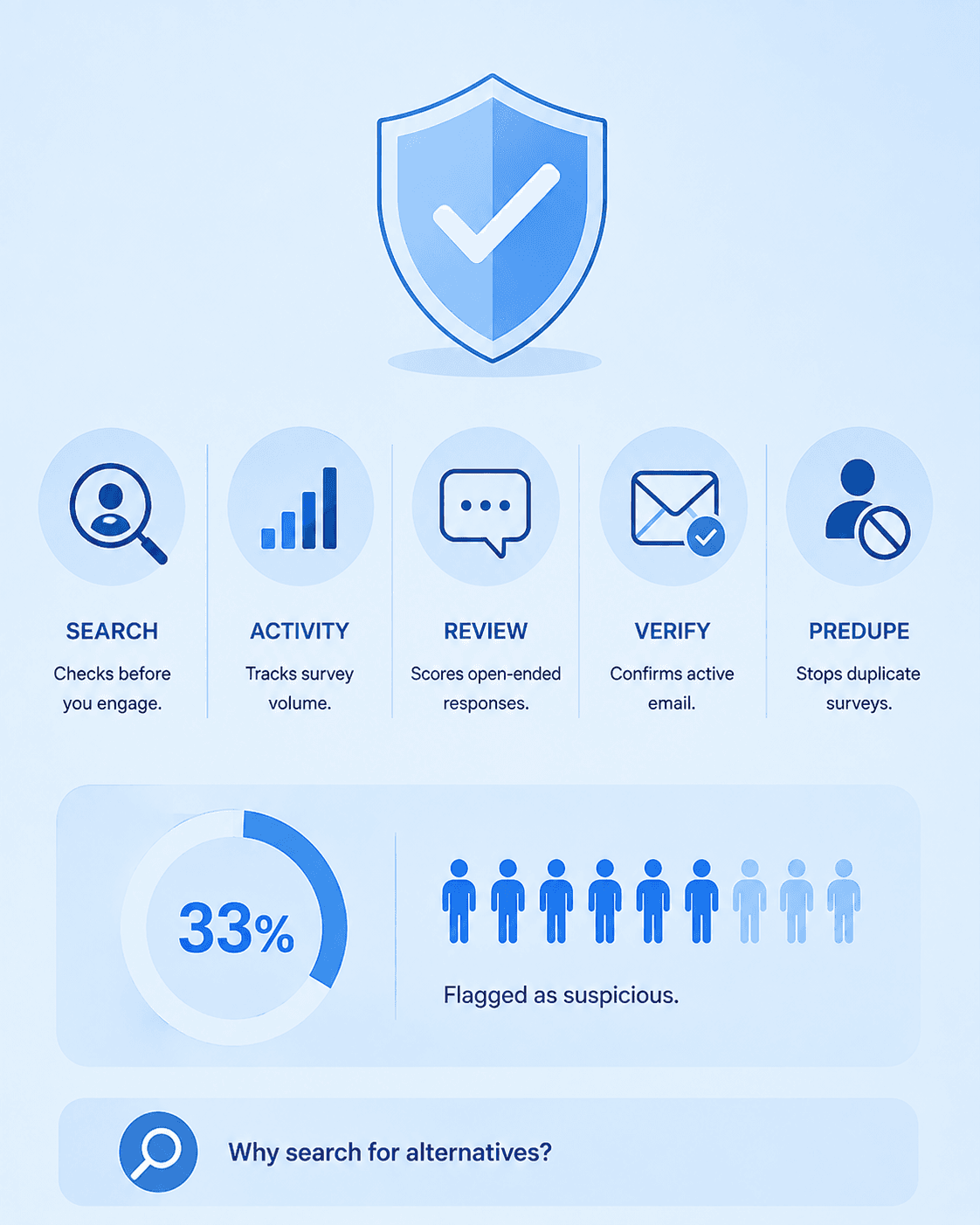
Research Defender earned its default status honestly. The platform is a set of modules that sit around programmatic sample:
- /SEARCH uses digital fingerprinting to examine respondents before you engage them. Bot, known fraudster, or duplicate?
- /ACTIVITY tracks a respondent's survey volume across the ecosystem, on the logic that people taking dozens of surveys a day produce worse data.
- /REVIEW scores open-ended responses in real time across 70-plus languages, checking grammar, length, profanity, and copy/paste behavior.
- /VERIFY confirms an email address is active and from a live domain.
- /PREDUPE stops a panelist from being sent to a survey they have already seen.
It works at scale, and the industry knows it. In a Quirk's study published in January 2026, Research Defender flagged 33 percent of more than 2,000 consumer respondents as suspicious. The uncomfortable part: nearly 70 percent of that flagged fraud passed traditional attention checks and data cleaning without a mark. The front door matters more than the broom.
So why is "research defender alternatives" a search term at all?
Why buyers start looking at Research Defender alternatives
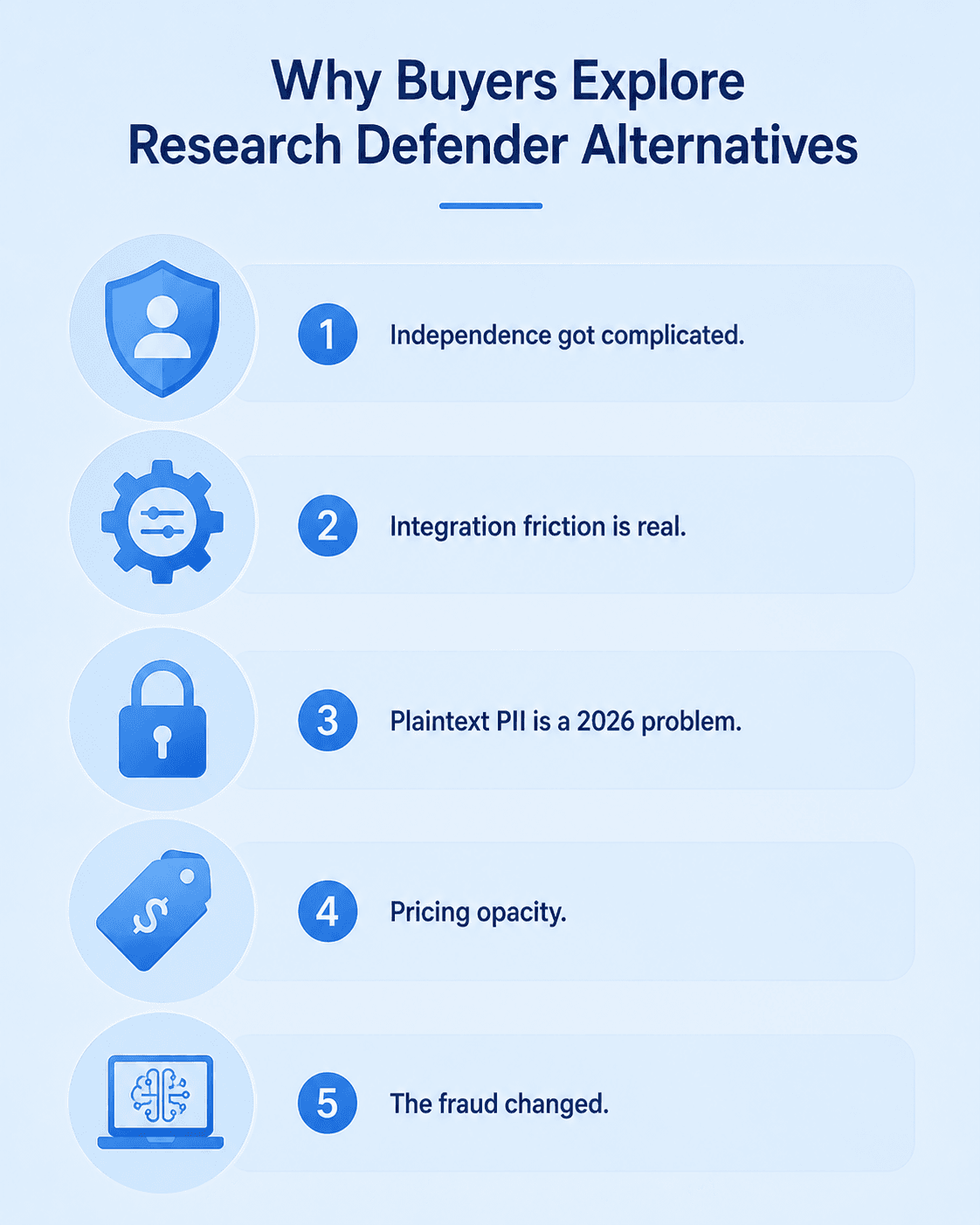
1. Independence got complicated. Research Defender built its name as a neutral referee that neither owned nor operated a panel. It is now part of Sago, one of the largest sample and research services businesses around. Many buyers don't care. Some do, especially agencies that compete with Sago and panels that dislike routing traffic through a tool owned by a company that also sells sample.
2. Integration friction is real. Tools from the panel-platform era assume redirect chains, survey-platform scripting, and per-project configuration. Wiring a legacy fraud layer into a modern stack can mean engineering tickets and weeks before one respondent gets scored. For a two-week tracker, that math fails.
3. Plaintext PII is a 2026 problem. Older integrations asked you to pass respondent identifiers, often raw email addresses, to a third-party API. Under GDPR, CCPA, and India's DPDP Act, each of those Research Defender Alternatives: A Buyer's Comparison (2026) Page 2 calls is a processing event you must document and defend. Buyers now want scoring from device and session signals, or hashed identifiers, with no plaintext personal data leaving their environment.
4. Pricing opacity. Enterprise minimums sized for sample exchanges don't fit a 40-person agency, and incumbents still mostly want a sales call before you see a number.
5. The fraud changed. AI-written open ends, device farms, and residential proxy pools didn't exist when most platforms were designed. Whatever you buy must catch 2026 fraud, not 2019 fraud.
What to demand from a fraud tool in 2026
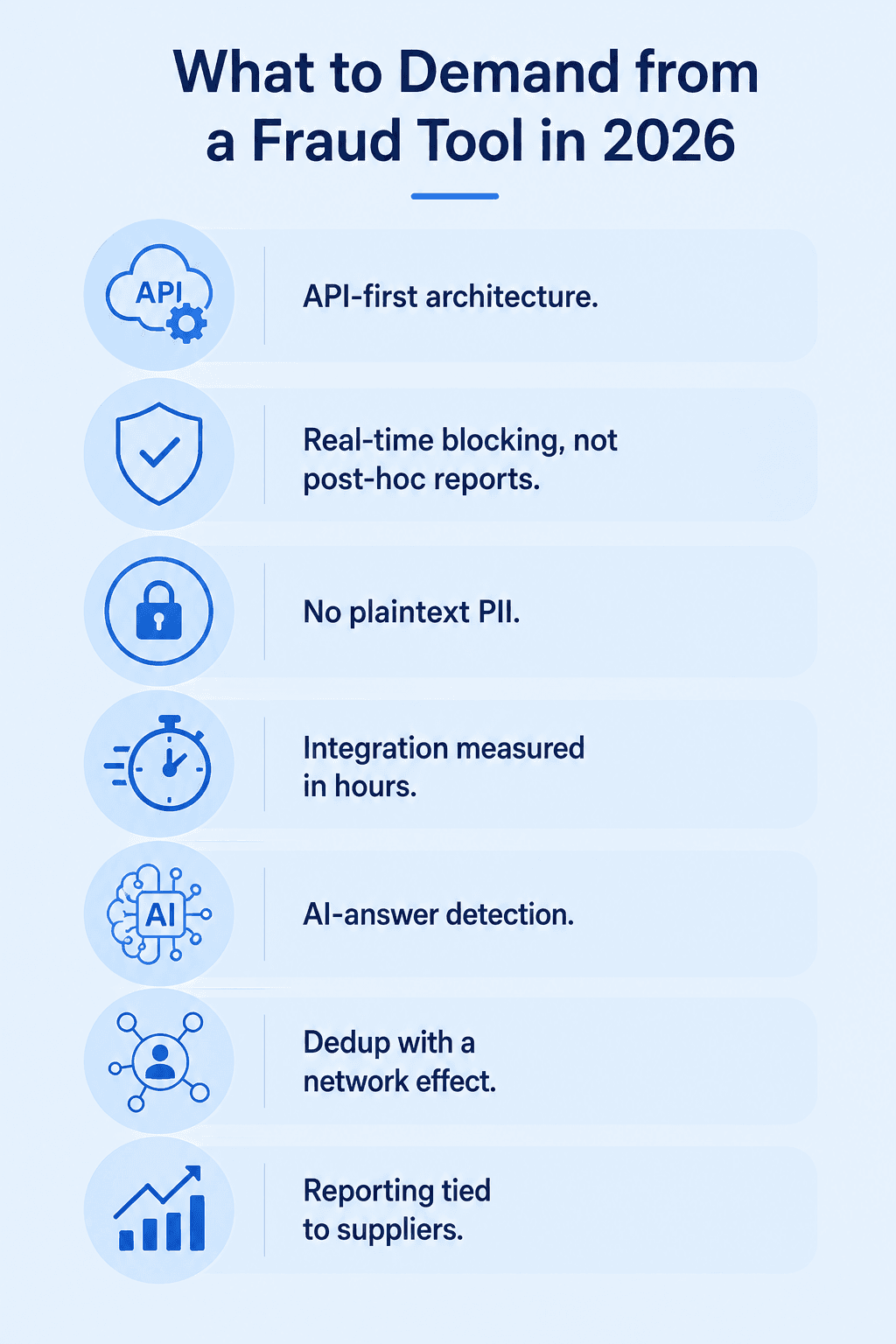
Before the vendor list, here is the scorecard I'd use for any research defender alternative:
- API-first architecture. One call at the survey entry point, a decision back in well under a second, sandbox keys without a procurement cycle, docs a developer can read. If the sales deck leads with the dashboard, the product was built for another era.
- Real-time blocking, not post-hoc reports. A score attached to a completed interview saves nothing on incentives or field time. Bad respondents should be redirected before question one.
- No plaintext PII. Ask every vendor: what identifiers do you need, in what form, where do they go? The 2026 answer is hashed identifiers or passive signals only.
- Integration measured in hours. A redirect link, a snippet, or a single API call. If implementation is a "phase," keep shopping.
- AI-answer detection. Model-written open ends are the fastest-growing fraud vector, and not every tool screens for them yet.
- Dedup with a network effect. Fingerprinting gets smarter when the vendor sees traffic across many buyers.
- Reporting tied to suppliers. A flag count is trivia. A per-supplier fraud rate you can bring to your next CPI negotiation is ammunition.
The alternatives, compared
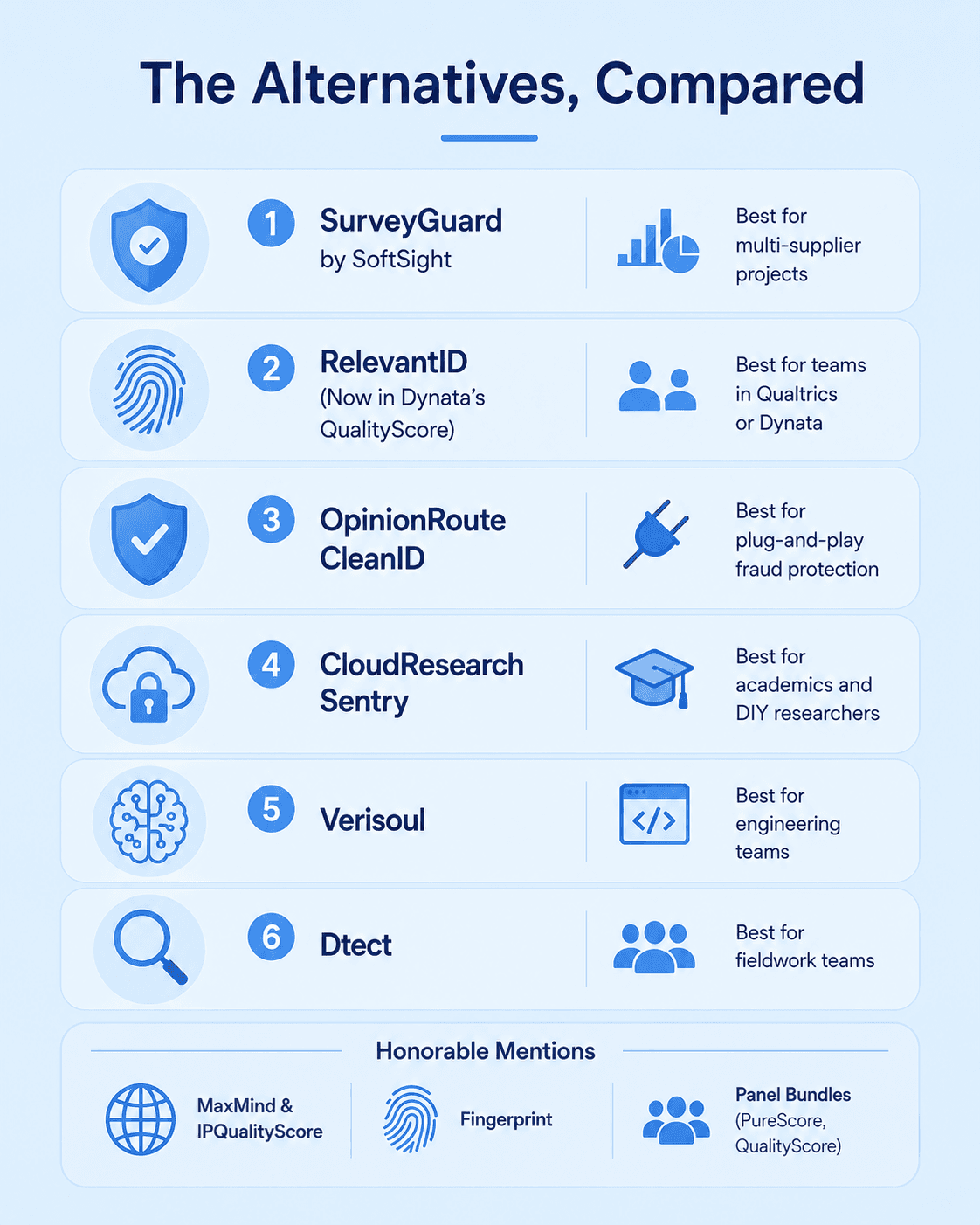
1. SurveyGuard by SoftSight
SoftSight is a newer company built around fieldwork operations, and SurveyGuard is its fraud layer. It sits at the survey entry point and evaluates every respondent across 15 detection layers in under 200 milliseconds, blocking bots, VPNs and proxies, duplicates, and AI-generated answers before they touch your data
Two design choices stand out. First, the architecture is API-first: built in the last couple of years, so the API is the product rather than a wrapper around a portal. Second, it scores respondents from device, network, and behavioral signals, and does not need plaintext personal identifiers to make a block decision, which keeps the GDPR conversation short.
The differentiator you won't find elsewhere on this list: SurveyGuard lives inside SoftSight's wider fieldwork platform, which coordinates suppliers from RFQ to reconciliation. Fraud flags feed supplier-level quality views, so the output isn't just "14 respondents blocked," it's which supplier sent them and what that means for your next negotiation. Best fit for agencies and ops teams running multi-supplier projects. Pricing is quote-based, with a 30-minute demo at softsight.io.
2. Imperium's RelevantID, now inside Dynata's QualityScore
RelevantID is the oldest name in respondent fingerprinting, with a well-documented scoring model: a fraud score from 0 to 130, where 30-plus reads as likely fraud, and a duplicate score from 0 to 100, where 75-plus means a repeat respondent. It's built into Qualtrics, which made it the default for academic and institutional research for years.
The big change: Dynata acquired Imperium, and in February 2026 announced it is folding RelevantID into QualityScore, its own quality engine. The upside is a more integrated, behavior-aware model with fewer false positives. The caveat mirrors the Sago story, squared: Dynata is the world's largest first-party panel, so the referee belongs to the biggest player on the field. In the classic Qualtrics setup, RelevantID also scores rather than blocks, so you still carry the cleaning workload. Best fit for teams already deep in Qualtrics or Dynata who want continuity.
3. OpinionRoute CleanID
CleanID calls itself anti-virus software for your survey, and the metaphor holds. It sits at the front door and checks each incoming respondent against roughly 800 device and session data points: browser, OS, IP, geolocation, VPN use, time zone, language settings, and behavior. High-risk respondents are terminated in real time; good ones pass through unnoticed.
Its real asset is the network effect. Because many research companies run it, the system learns fraud patterns across industry traffic and stays current against new tactics. Setup is an API plugin or a DIY portal, and OpinionRoute advertises a 30-day free trial, making it the easiest tool here to pilot on a live project. Best fit for agencies that want a plug-and-play shield without an engineering project.
4. CloudResearch Sentry
Sentry comes from CloudResearch, the company academics know from its MTurk toolkit, and it shows. It works with nearly any survey platform via link or API, and module toggles let you relax individual checks on low-incidence studies where feasibility matters. It was also early to advertise blocking of AI-written survey responses.
The tradeoff: it's strongest in academic and crowdsourced-sample work. Enterprise teams running large multi-supplier trackers may find supplier-level reporting thinner than dedicated platforms. Best fit for academic teams, DIY researchers, and anyone sourcing from online panels or crowdsourcing platforms.
5. Verisoul
Verisoul is the most engineering-native option on this list. It positions itself as a machine learning fraud platform whose models continuously learn new patterns rather than relying on static rules: device intelligence, behavioral signals, and identity clustering, spoken fluently in APIs and webhooks.
What it lacks is market research specificity. It serves fraud teams across industries, so respondent-centric features like open-end quality scoring aren't baked in. If you have engineers and want a tunable fraud layer, take a look. If you want something that understands sample, look elsewhere.
6. Dtect
Dtect keeps it simple: an API that tags each incoming participant as good, suspicious, or bad, plus a web portal tracking project and supplier health live. That supplier view mirrors how fieldwork managers actually think about quality. Public detail on its detection depth is thinner than the others, so treat it as one to pilot rather than one to buy on paper. Best fit for fieldwork-heavy teams wanting a lightweight tagging layer with supplier visibility.
Honorable mentions
MaxMind and IPQualityScore aren't survey tools at all, but nearly every platform above leans on services like them for IP and geolocation intelligence, and you can license them directly if you're building in-house. Fingerprint is the leading general-purpose device fingerprinting API for the same DIY route. And if you buy sample from a single major panel, bundled systems like PureSpectrum's PureScore or Dynata's QualityScore may already cover you, at the cost of being tied to one supplier's view of the world.
Quick comparison
| Tool | Where it sits | Blocks or scores | Setup friction | PII posture | Best fit |
|---|---|---|---|---|---|
| SurveyGuard (SoftSight) | Survey entry point | Blocks, under 200ms | Low, API-first | Signal-based, no plaintext PII needed | Multi-supplier agency ops |
| RelevantID / QualityScore (Dynata) | In-platform (Qualtrics) | Mostly scores | Low if on Qualtrics | Vendor database checks | Qualtrics and Dynata shops |
| CleanID (OpinionRoute) | Survey front door | Blocks | Low, API or portal | Server-to-server, security reviewed | Plug-and-play agency shield |
| Sentry (CloudResearch) | Link or API | Blocks, modular | Low | Minimal data needs | Academic and DIY research |
| Verisoul | API layer | Scores and flags | Medium, dev-led | Configurable | Engineering-led teams |
| Dtect | API plus portal | Tags and blocks | Low to medium | Not publicly detailed | Supplier-health tracking |
Details in this table come from vendor documentation and public sources as of mid-2026. This space moves fast, so verify current specs with each vendor before you sign.
How to actually choose
Match the tool to the failure mode you keep hitting.
Running multi-supplier trackers, with pain that's operational (fraud plus supplier chaos plus reconciliation)? Pick the tool that treats fraud as part of fieldwork operations. That's SurveyGuard's bet, and it's why it tops this list for agency buyers.
Deep in Qualtrics with one or two big panels? RelevantID inside QualityScore is the path of least resistance, ownership caveat noted.
Want proof before committing? CleanID's trial is the lowest-risk pilot. Academic or crowdsourced sample? Sentry was built for you. Engineers and unusual requirements? Verisoul, or a MaxMind plus Fingerprint stack, gives you raw materials.
Whatever you choose, pilot on a live project with a control cell. Fraud rates vary wildly by country, category, and supplier, and the only benchmark that matters is your own traffic.
The bottom line
Research Defender is still a credible tool, and for some buyers it's still the right one. But the market around it moved. Consolidation at Sago and Dynata put the independence question on the table, and a new generation of API-first tools made six-week integrations and emailed respondent files feel like relics.
In 2026, the bar for a research defender alternative is simple: a sub-second decision at the door, an API you can test the same day, and a design that never asks for plaintext PII. SurveyGuard by SoftSight clears that bar and adds supplier-level operations on top, which is why it's the first call I'd make. CleanID is the easiest pilot, RelevantID the incumbent comfort pick, and Sentry the academic favorite.
To see the SurveyGuard approach before finalizing your shortlist, SoftSight runs a 30-minute demo led by people who have run fieldwork themselves. You can book it at softsight.io. Your cleaning team will thank you.