Survey fraud is widely acknowledged as a problem in online market research. It is less widely understood in its operational detail — specifically, how fraud actually works, what fraudsters are doing, and why the defences that most agencies currently rely on are insufficient.
This is a field guide. Not a reassuring overview. A practical account of the fraud landscape as it exists today.
Layer 1: The Simple Fraudster
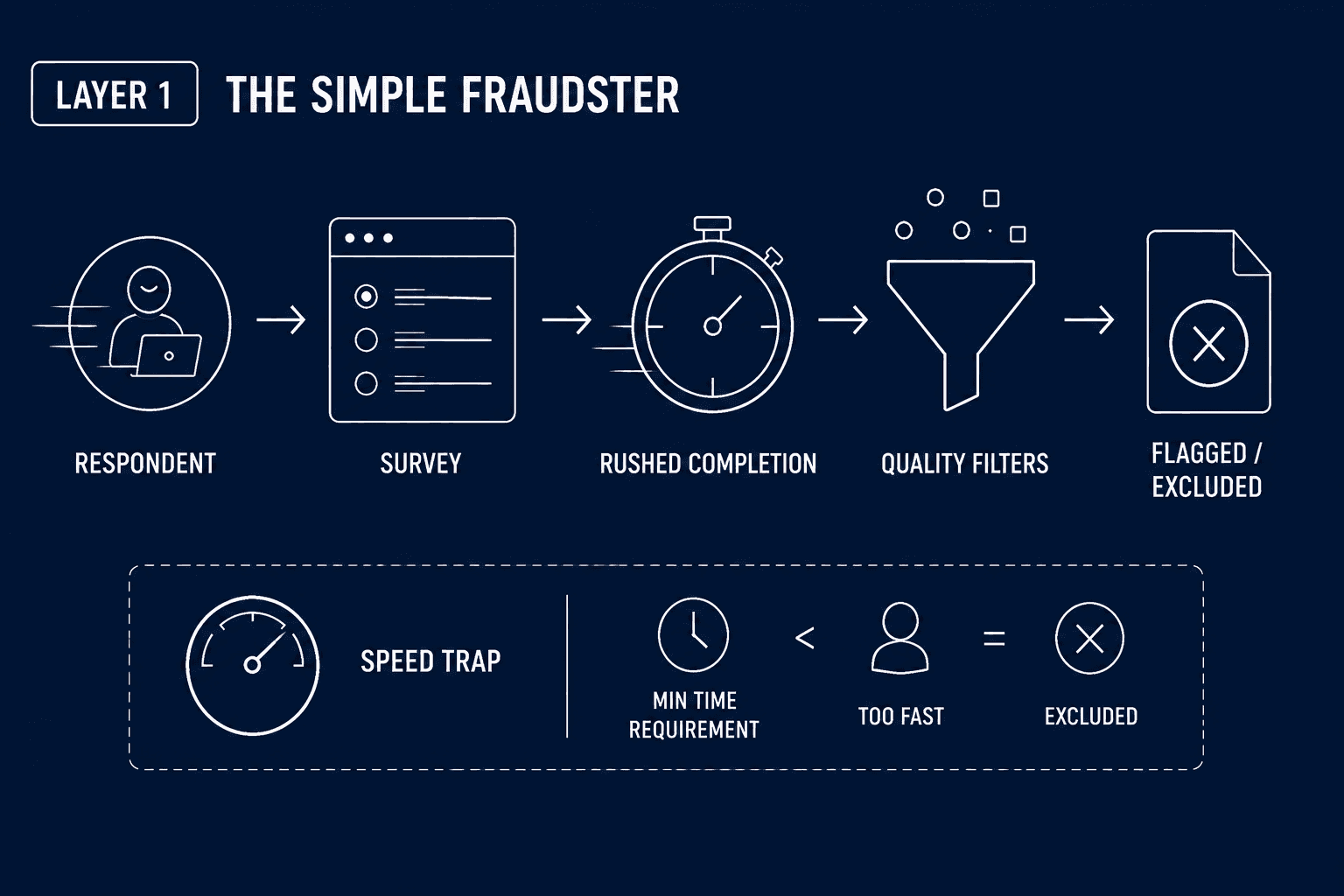
The simplest form of survey fraud is speed: a respondent who rushes through a questionnaire, selecting answers at random or in patterns, with no intention of reading the questions. A ten-minute survey completed in ninety seconds is a simple speedster.
Speed traps catch these respondents. A minimum time requirement — if a respondent completes below a threshold time, they are flagged or excluded — is a standard quality measure that most platforms support. Simple speeders are the least sophisticated fraud and are widely detected.
Layer 2: The Profile Fraudster
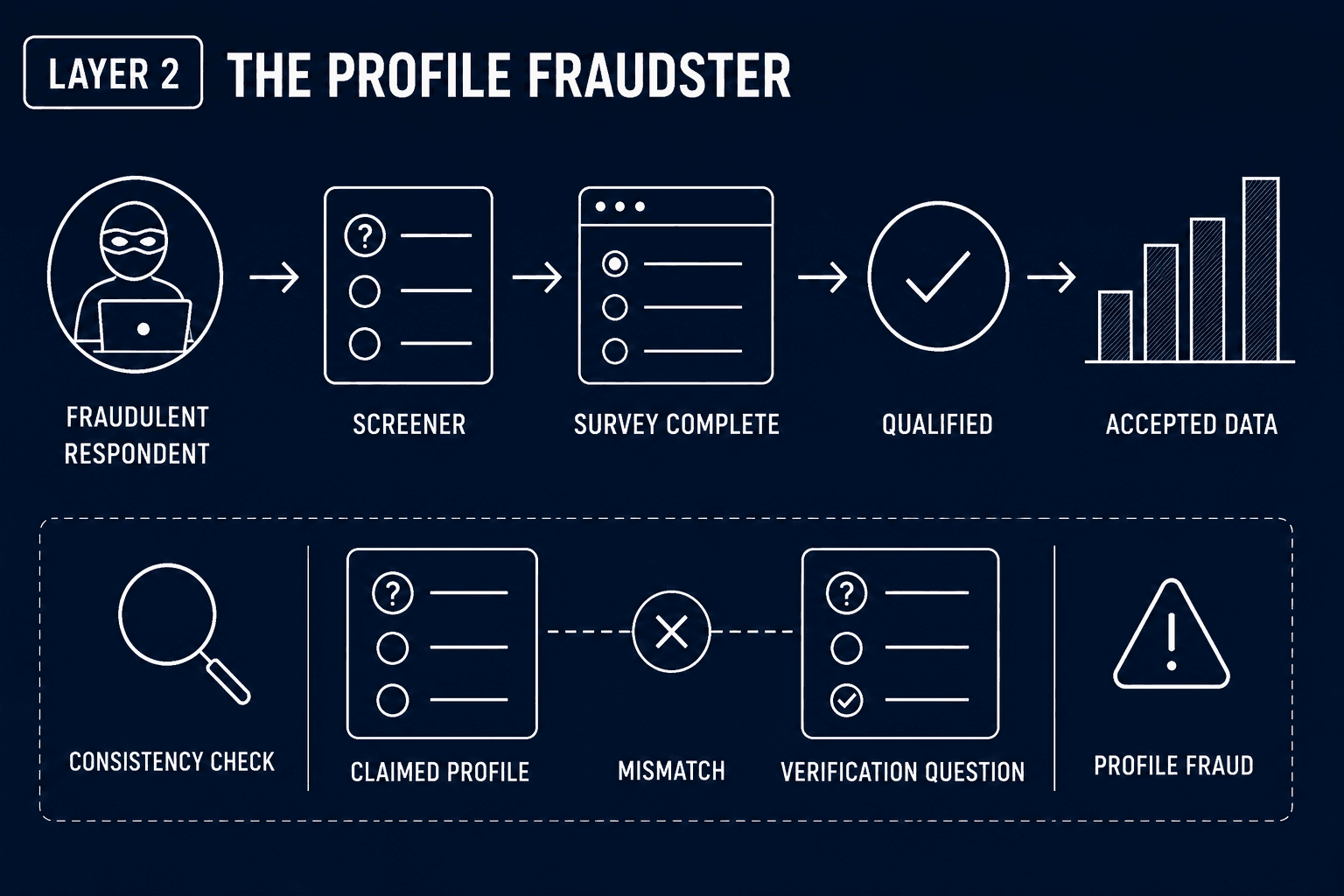
More sophisticated is the respondent who misrepresents their profile to qualify. A study targeting small business owners is more lucrative — higher CPI — than a study targeting general consumers. Respondents who claim to be small business owners when they are not pass the screener, complete the survey, and are counted as completes.
Consistency checks help here: pairs of questions that should logically align (claiming to own a business but not knowing their approximate annual revenue range, for example) can identify misrepresentation. But profile fraud requires domain-specific trap design and is not caught by generic checks.
Layer 3: The Technical Fraudster
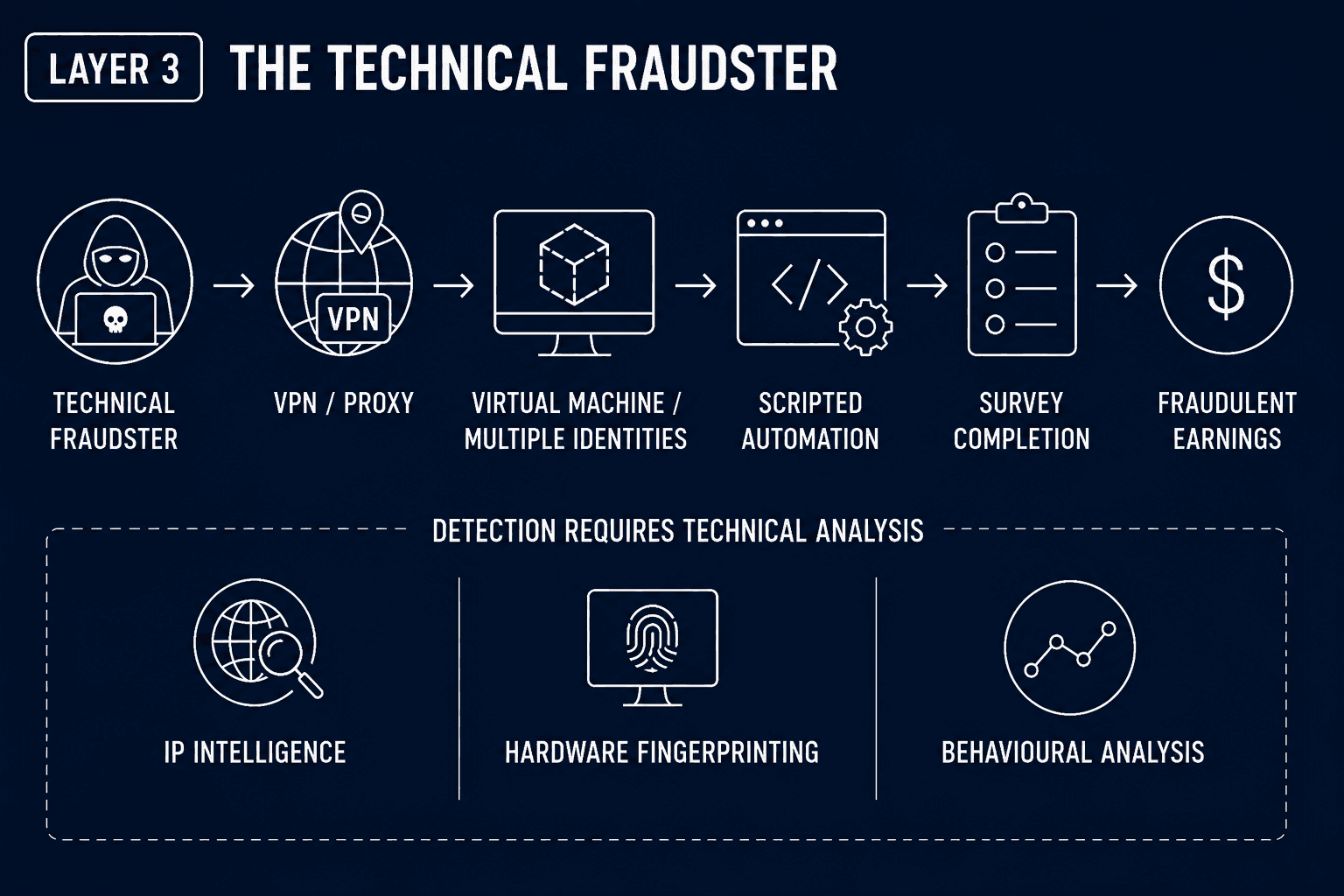
The technical fraudster uses tools to multiply their income: VPNs to appear in target geographies where they do not reside, virtual machines to run multiple identities from a single device, and scripted automation to complete surveys faster than any human could.
These are the fraud types that standard quality checks miss entirely. A speed trap does not catch a VPN user who reads every question carefully. An attention check does not identify a datacenter IP address. A consistency check does not detect a virtual machine.
Detection requires technical analysis: IP intelligence (identifying VPN exit nodes, proxy servers, and datacenter IP ranges), hardware fingerprinting (identifying virtualised environments from GPU and system characteristics), and behavioural analysis (identifying movement patterns that deviate from human norms).
Layer 4: The Professional Survey Taker
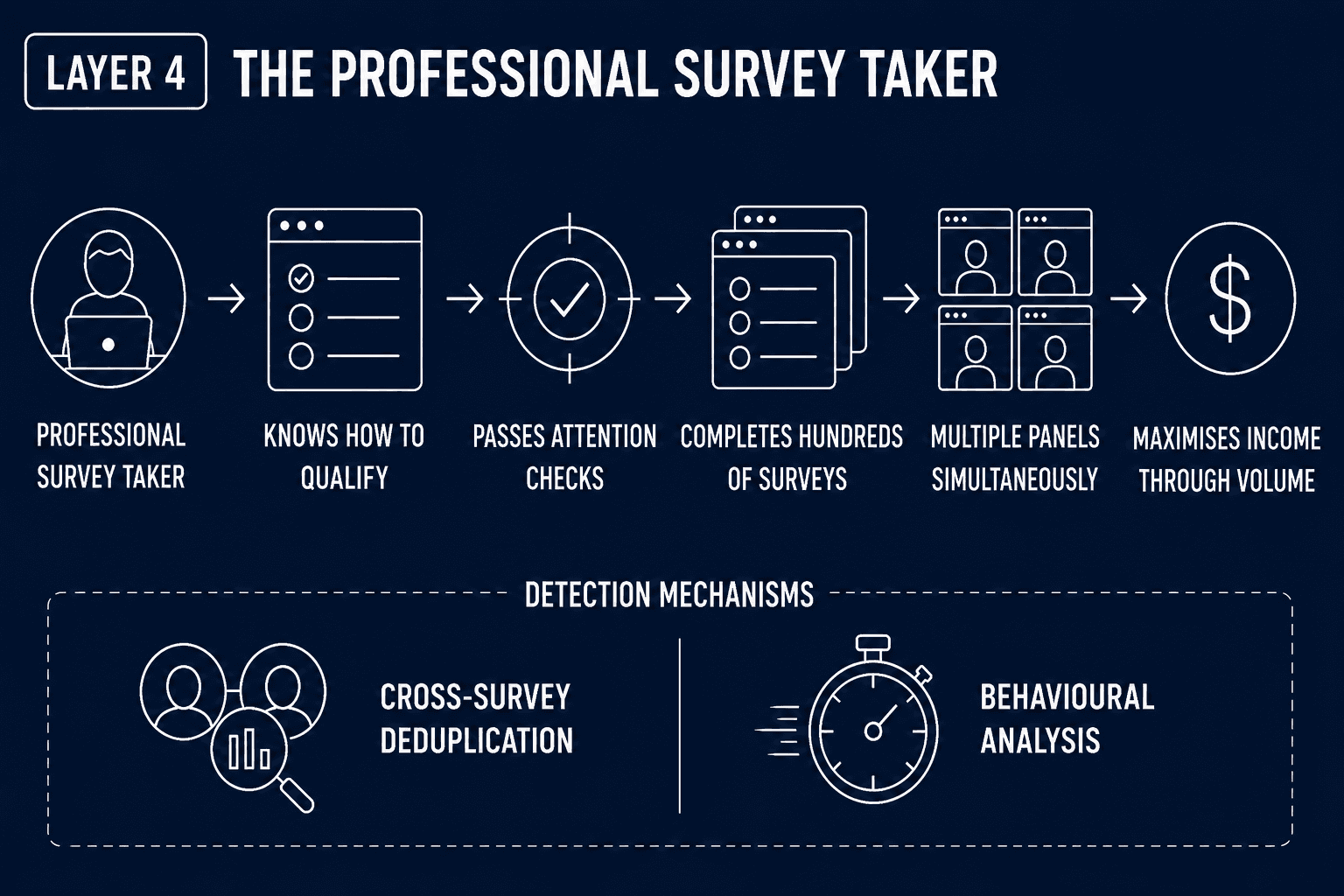
Professional survey takers are not fraudsters in the technical sense — they are real people, in the right geography, completing surveys intentionally. But they have learned the system so thoroughly that their responses are systematically unreliable.
They know which screener answers qualify. They know how to pass attention checks. They have completed hundreds of surveys on the same topics and have developed a repertoire of plausible answers that require no genuine engagement. They complete surveys on multiple panels simultaneously, maximising income by maximising volume.
Cross-survey deduplication — identifying respondents who appear in an abnormal volume of studies across a platform — is the primary detection mechanism. Behavioural analysis that identifies suspiciously efficient completion patterns also catches many professional takers.
Layer 5: The AI-Assisted Fraudster
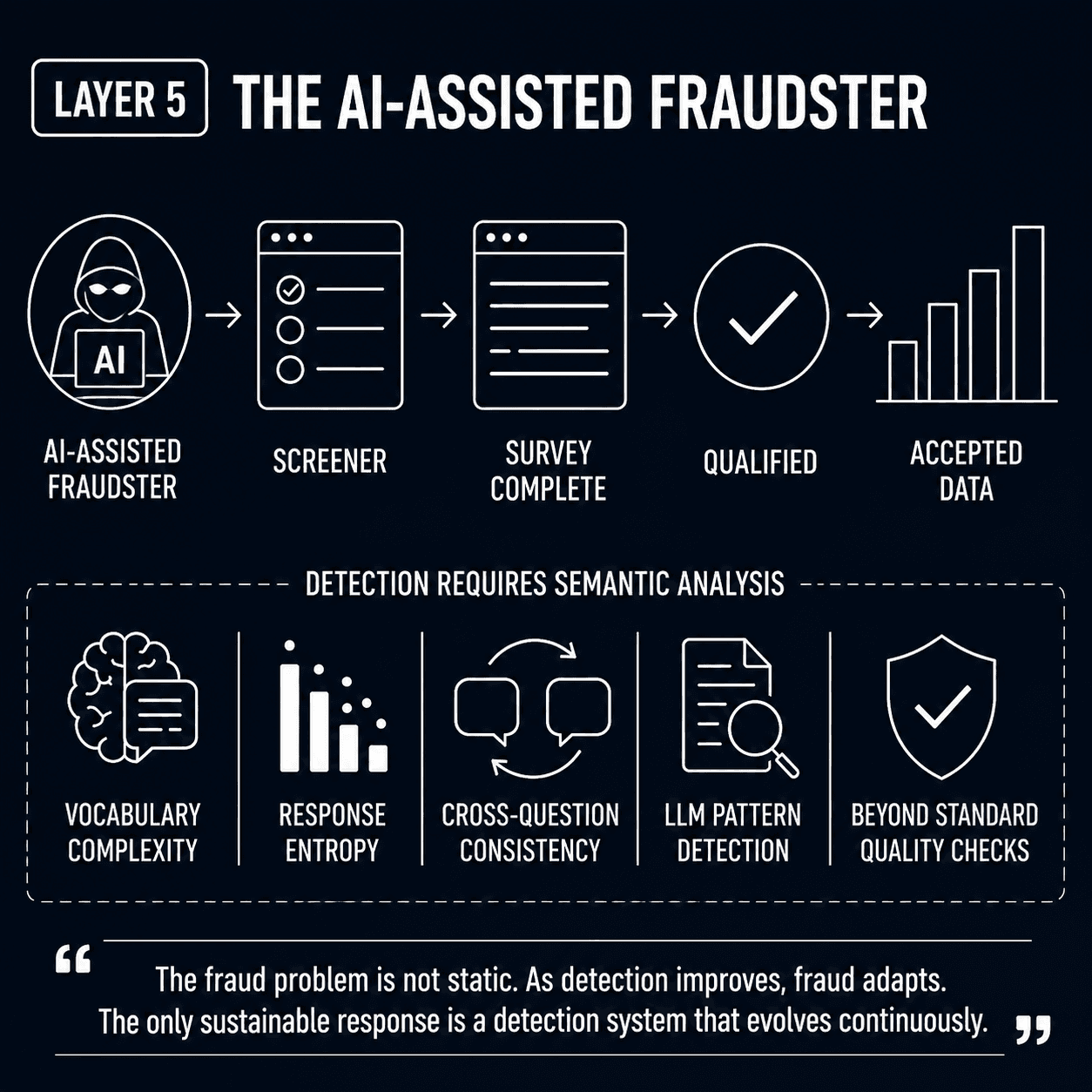
The newest and fastest-growing fraud type uses large language models to generate responses to open-ended questions. A fraudster using an LLM to complete a survey does not speed. Does not straightline. Does not fail attention checks. Their open-ended responses are coherent, relevant, and apparently thoughtful.
Standard quality checks are entirely blind to this. Detection requires semantic analysis: examining vocabulary complexity, response entropy, cross-question consistency, and the specific patterns that LLM-generated text exhibits compared to genuine human expression.
“The fraud problem is not static. As detection improves, fraud adapts. The only sustainable response is a detection system that evolves continuously.”
What Effective Detection Actually Requires
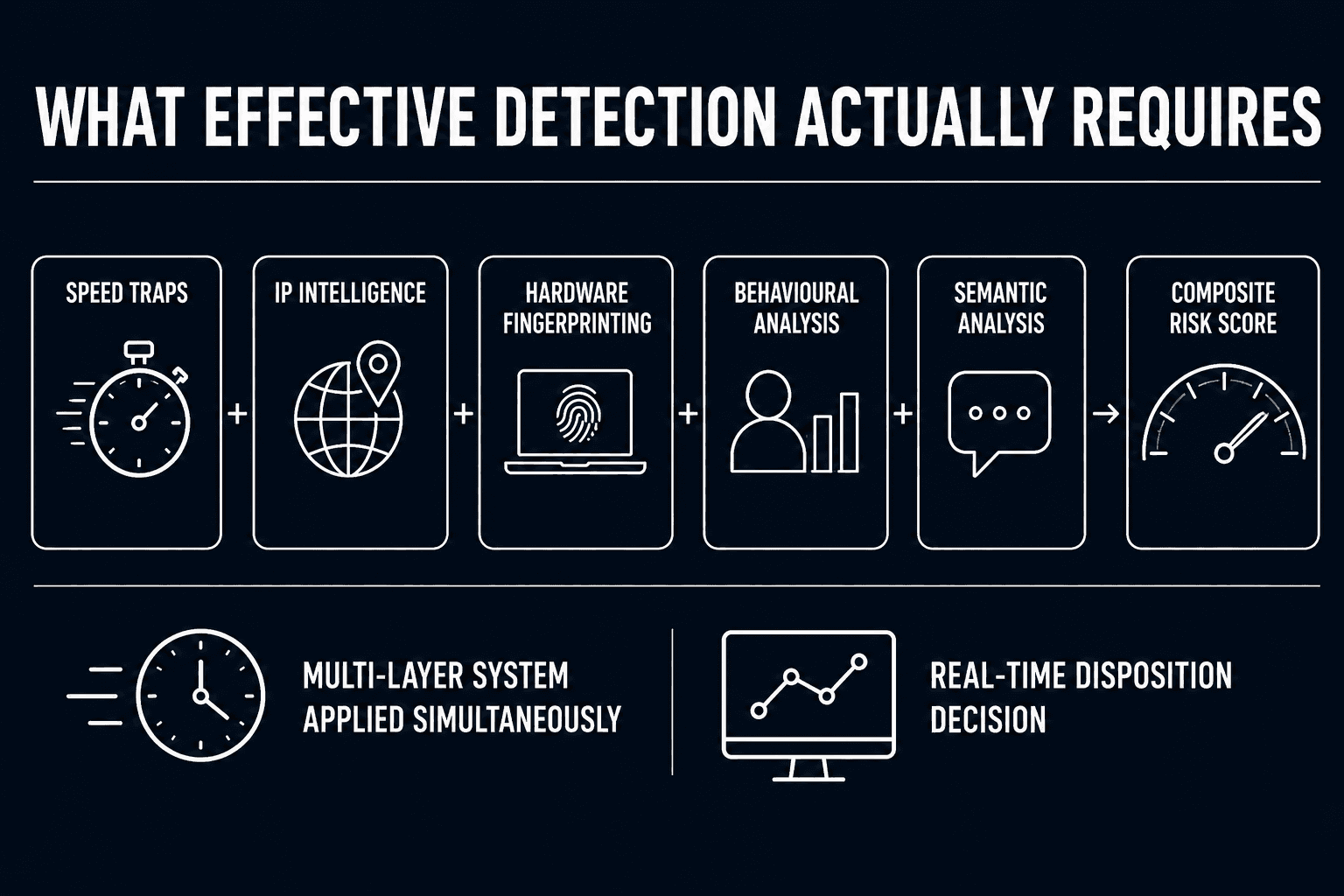
The implication of this taxonomy is that no single detection mechanism is sufficient. Speed traps catch one layer. IP intelligence catches another. Hardware fingerprinting catches a third. Behavioural analysis catches a fourth. Each layer is necessary; none is sufficient.
Effective fraud detection is a multi-layer system that applies all mechanisms simultaneously, combines the signals into a composite risk score, and makes a disposition decision in real time — before the response is recorded.
The key word is real time. Post-fieldwork data cleaning can remove fraudulent responses that have already been recorded. It cannot undo the structural bias they have introduced into a dataset that may have informed a decision before cleaning was complete.
SoftSight — SurveyGuard applies 15 detection layers in under 200ms per respondent. softsight.io