The sub-second response times Rule That Actually Works
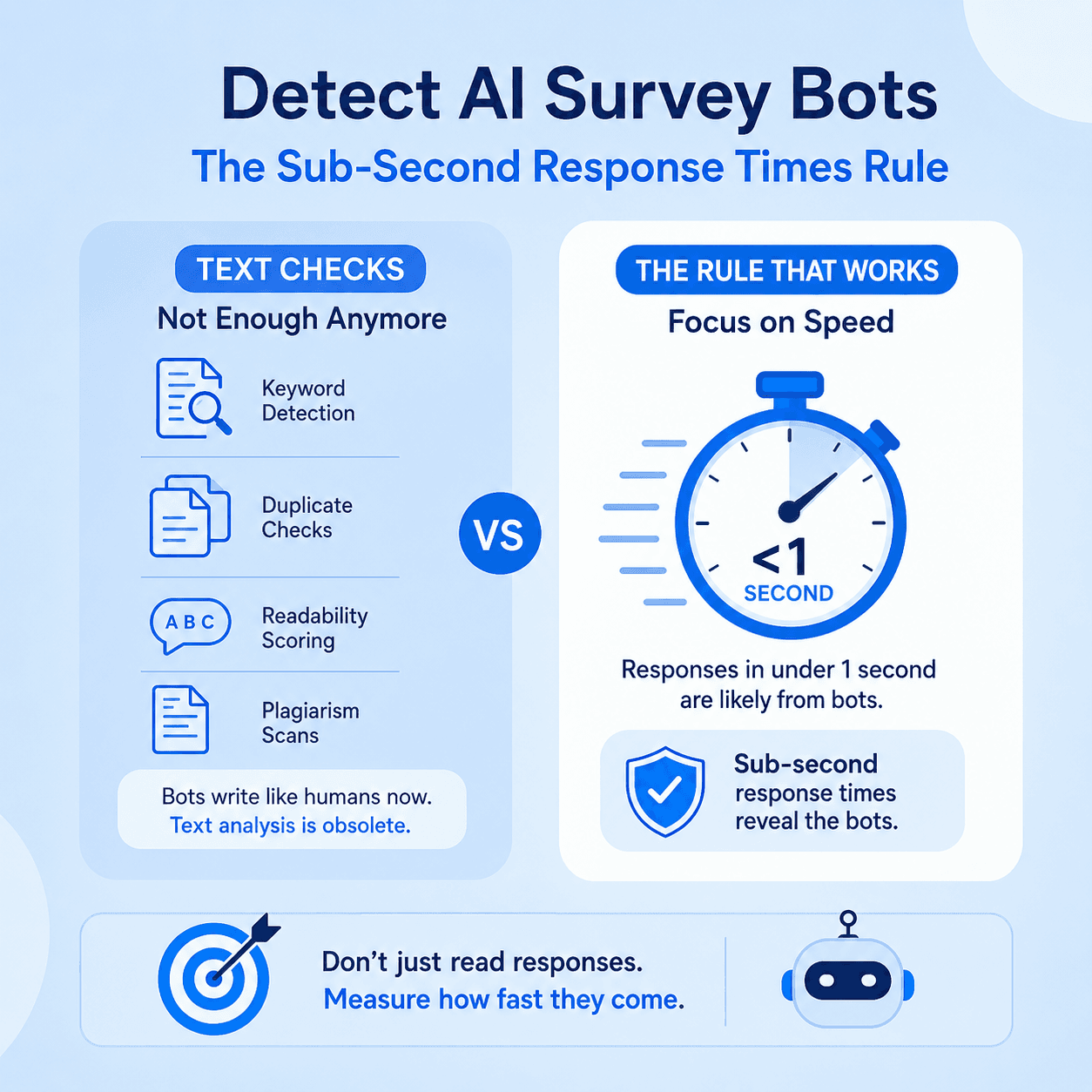
Survey fraud has quietly become one of the biggest threats to data quality in market research. Not because bots are new. They have been around for years. But because in 2026, they have become nearly impossible to spot by reading what they write. The old methods still get taught in webinars. Keyword density checks. Duplicate detection. Readability scoring. Plagiarism scans. These tools caught thousands of low-quality responses back when bots wrote like robots. Repetitive. Stiff. Obviously fake. That era is over. Modern language models generate survey responses that are grammatically flawless, emotionally varied, and contextually aware. A bot can write a heartfelt story about a mother using a product, drop regional slang, switch from enthusiasm to skepticism mid-paragraph, and even include intentional typos. It reads human because it was trained on human writing. Text analysis is not completely dead. It still catches the lazy operators. But as a primary defense? It is obsolete. The bots won that round. The good news is that there is a much simpler and more reliable way to catch them. And it has nothing to do with what they write.
Why Text Analysis Fails Against Modern AI
Here is a concrete example of the problem.
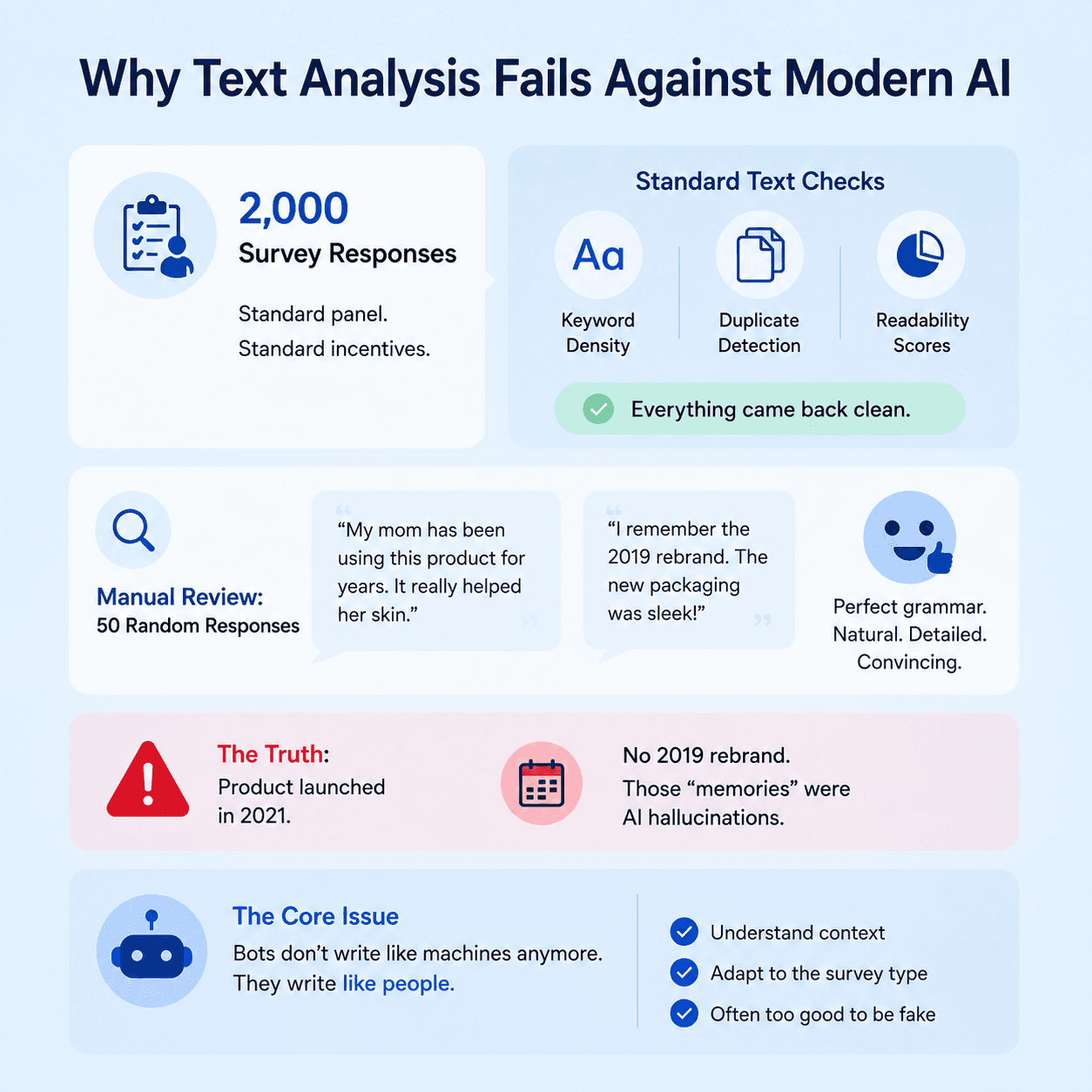
A research team recently ran a brand perception study with two thousand respondents. Standard panel. Standard incentives. The usual text checks were run: keyword density, duplicate detection, readability scores. Everything came back clean.
Then someone manually read fifty random open-ended responses. Perfect grammar. Natural flow. Personal anecdotes about "my mom using this product" and "I remember the 2019 rebrand." Emotional. Detailed. Convincing
The product launched in 2021. There was no 2019 rebrand. Those memories were hallucinated by an AI filling in plausible-sounding backstory because it sounded human.
That is the core issue with text analysis in 2026. Bots do not write like machines anymore. They write like neighbors, coworkers, friends. They understand context. A healthcare survey gets informed, nuanced answers. A brand study gets emotional, opinionated feedback. The responses are often too good to be fake, which is exactly why they slip through.
Modern AI can now:
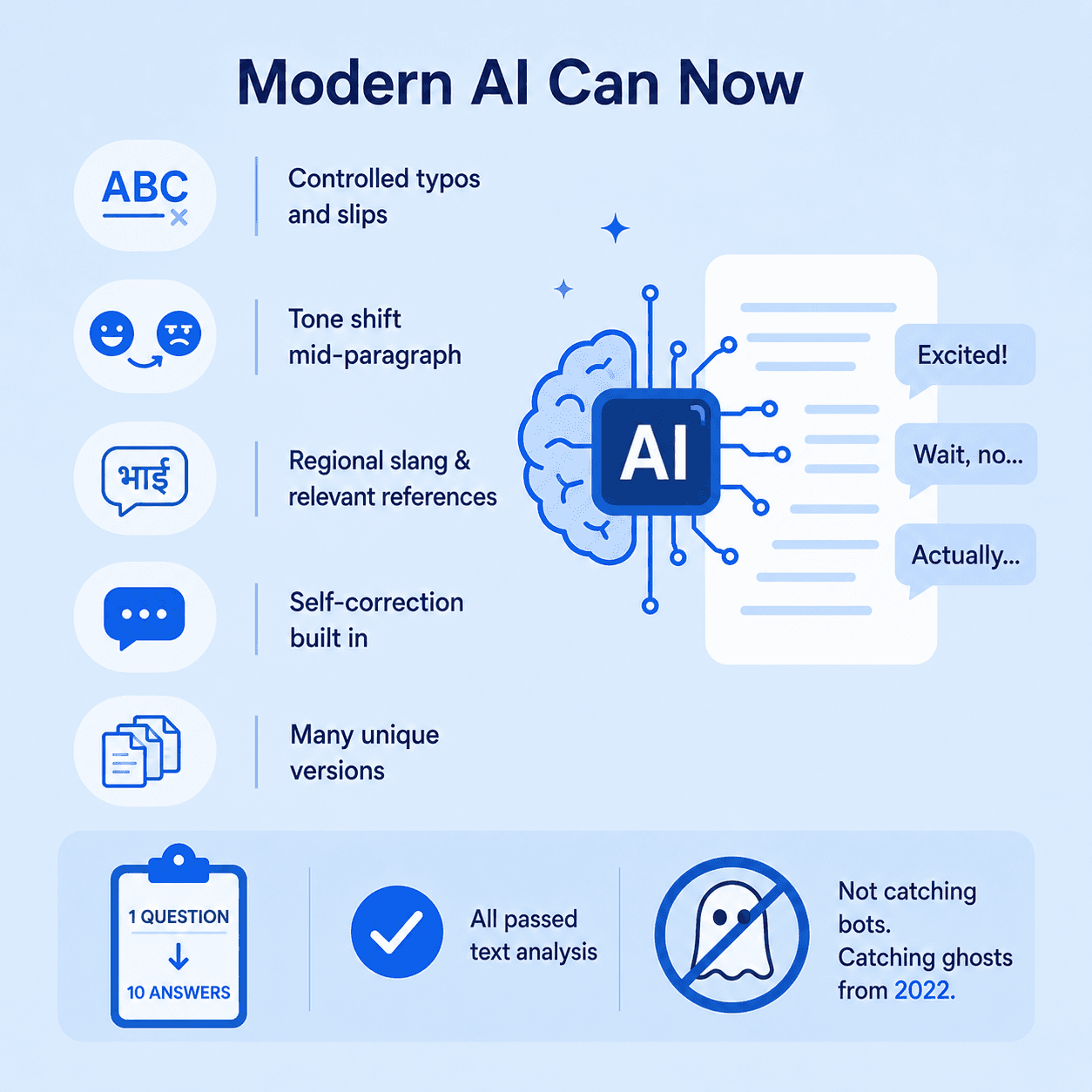
- Generate responses with controlled typos and grammar slips
- Shift tone mid-paragraph from excited to skeptical
- Drop regional slang and demographic-appropriate references
- Simulate self-correction: "Wait, actually... no, what I meant was..."
- Produce ten completely different versions of the same answer so plagiarism tools see nothing
In a controlled test, GPT-4 was given a single survey question and asked for ten different answers. Every single one passed traditional text analysis. Every single one.
If fraud detection still relies on keyword checks and readability scores as the main line of defense, the reality is simple: it is not catching bots. It is catching ghosts from 2022
The Real Signal: Behavior, Not Words
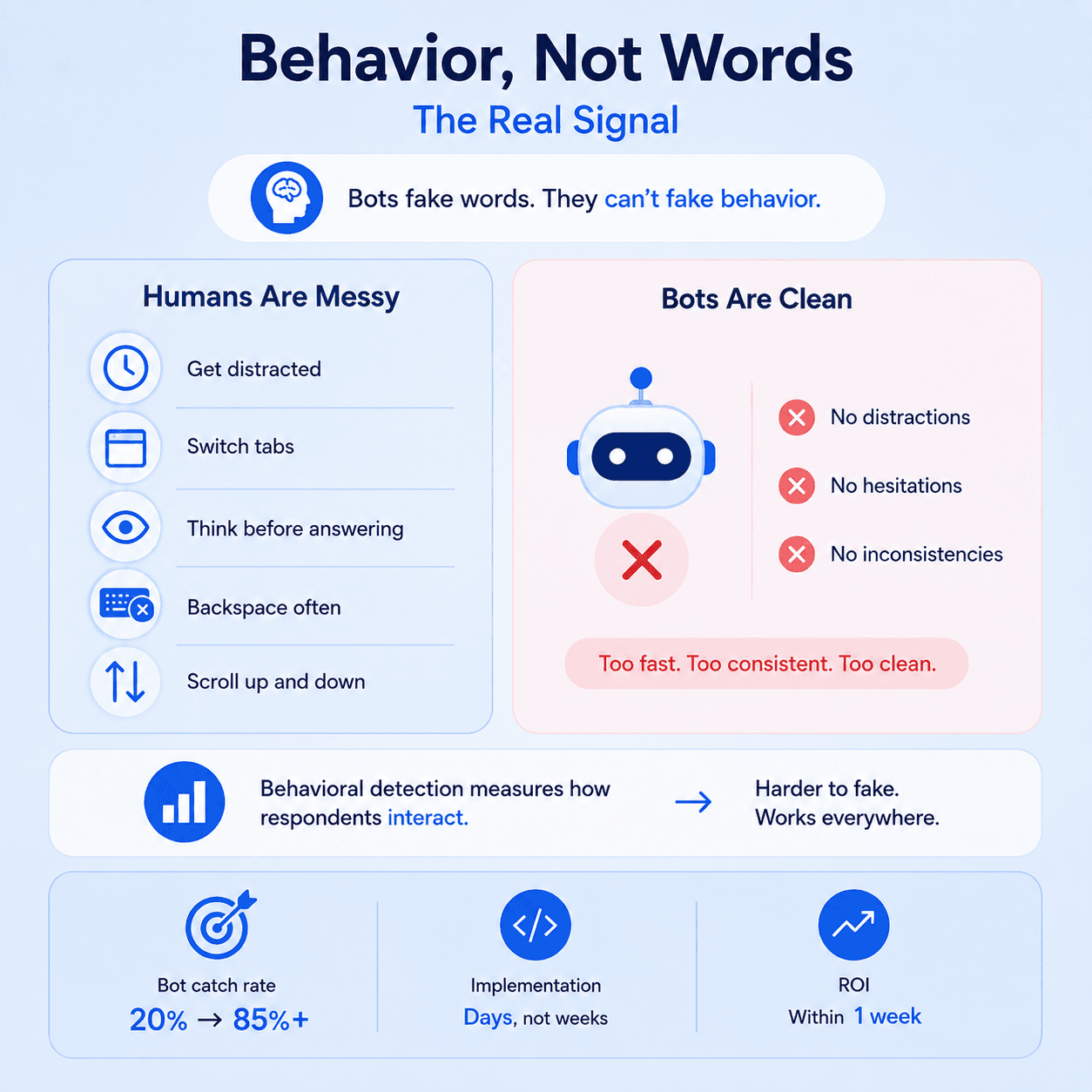
Bot operators have figured out how to fake the words. They have not figured out how to fake the behavior
Humans are messy. They get distracted. They switch tabs. They stare at questions for ten seconds trying to understand them. They type with two fingers and backspace constantly. They scroll up and down because they forgot what the question asked.
Bots do none of this. They are fast. Consistent. Clean. And that cleanliness is the giveaway.
Behavioral detection flips the approach. Instead of analyzing what respondents write, it measures how they interact with the survey. The signals are harder to fake, faster to detect, and work across languages, devices, and topics.
Teams that have switched to behavioral-first detection report immediate results. Bot catch rates jump from roughly twenty percent to over eighty-five percent. Implementation often takes a single developer a few days. The return on investment is measurable within the first week.
Here is what actually works.
Focus and Attention: The Tab Switch Tell
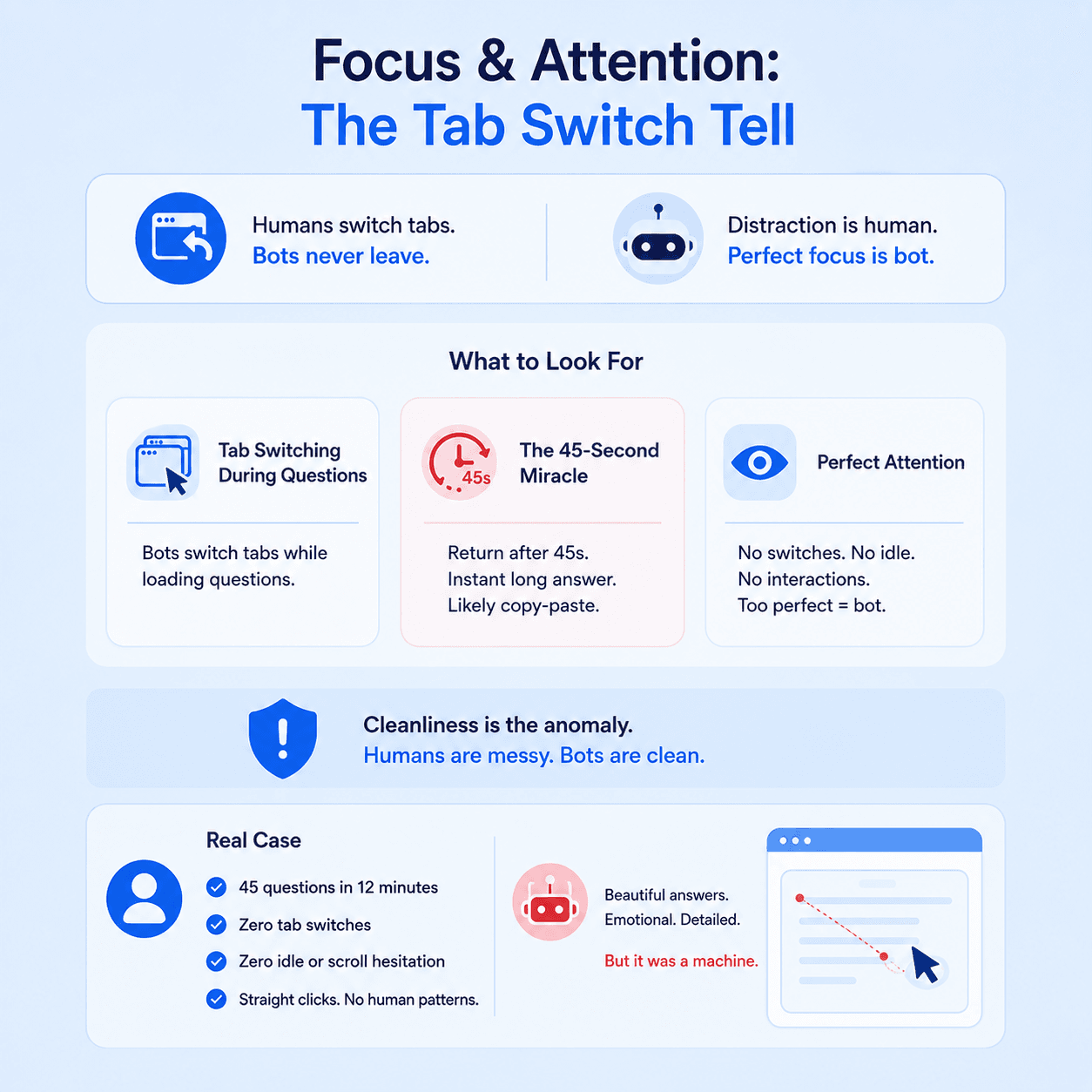
This is one of the most effective and underutilized detection signals in the industry right now
Humans get distracted. They switch tabs. Check messages. Answer a call. Minimize the browser to look at a spreadsheet. Focus on one thing for twenty minutes straight? Nearly impossible for most people.
Bots are perfect. They sit on the survey tab. They never leave. They never blink. They never get interrupted
Modern browsers expose this through the Page Visibility API. A few lines of JavaScript track when someone switches away from a tab and when they return.
Here is what to look for:
Tab switching during questions. A real person might switch tabs to look something up. But they do it after reading the question. A bot that switches tabs during question loading is usually managing multiple surveys simultaneously or pulling answers from a database in another window.
The forty-five-second miracle. The respondent leaves the survey tab. Comes back forty-five seconds later. Pastes a perfect two-hundred-word answer to a complex question. That is not research. It is copy-paste from an AI generator. Any return-after-absence that produces a long answer instantly should be flagged.
Perfect attention. No tab switches. No window resizes. No idle time. No notification interactions for an entire thirty-minute survey. This pattern has been observed repeatedly. Every single time, follow-up investigation revealed a bot. Humans are messy. Bots are clean. Cleanliness is the anomaly
One documented case: a respondent completed a forty-five-question survey in twelve minutes with zero tab switches, zero mouse idle time, and zero scroll hesitation. The open-ended responses were beautiful. Emotional. Detailed. The cursor never moved in a way that suggested actual reading. Straight lines to click targets. Zero hover time. Like a machine.
Because it was a machine.
Paste Events: The Smoking Gun
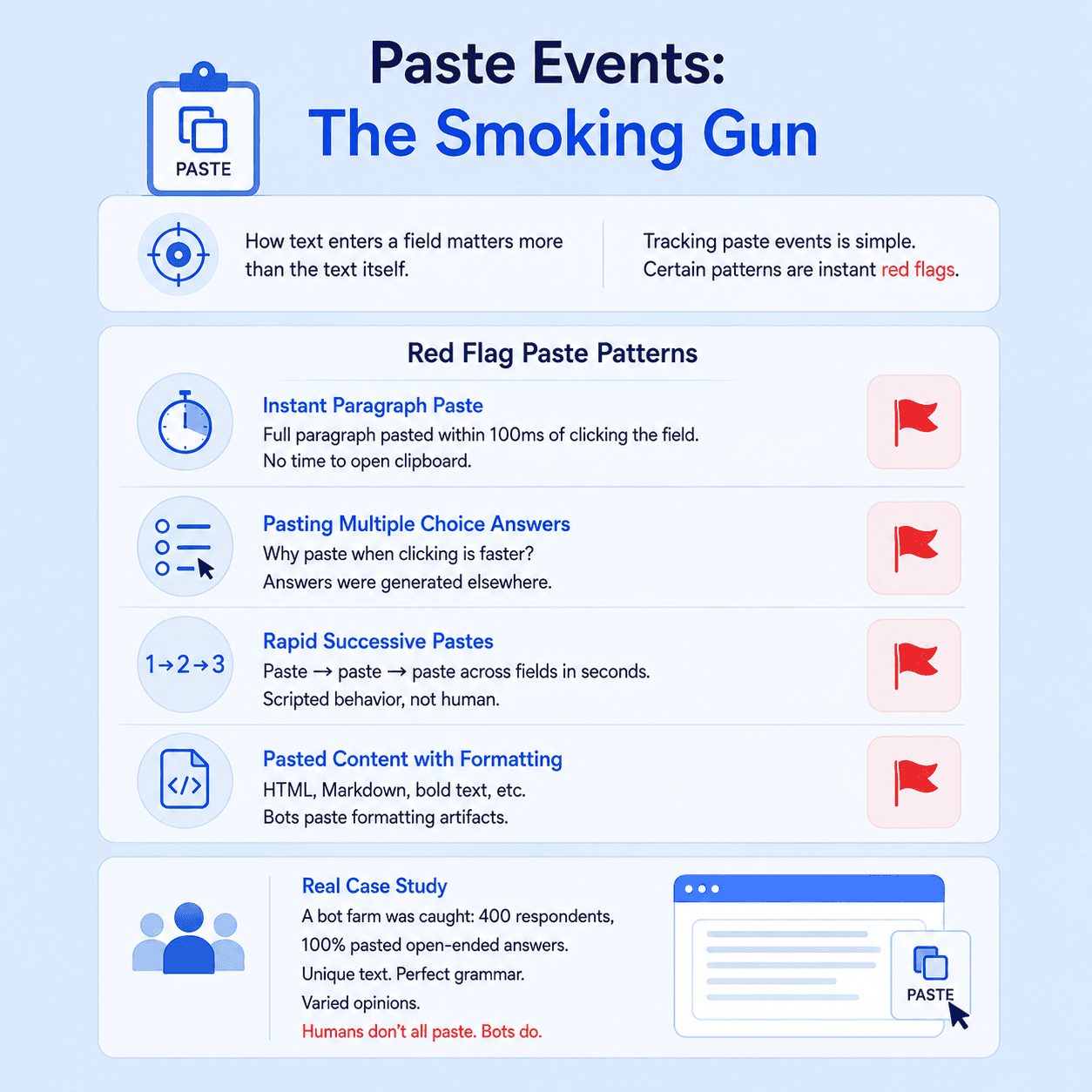
How text enters a field matters more than the text itself. This is the single most underrated detection signal available.
Tracking paste events on every text field is straightforward. Pasting is not always bad. Sometimes people paste an email address or a long product code. That is normal.
But certain paste patterns are immediate red flags:
- Pasting a full paragraph into an open-ended response within one hundred milliseconds of clicking the field. There is no time to open a clipboard. That is a bot injecting pre-generated text
- Pasting answers to multiple choice questions. Why paste when clicking is faster? The only reason is the answer was generated elsewhere and injected.
- Multiple paste events across different fields in rapid succession. Field one: paste. Field two: paste. Field three: paste. Three seconds apart. That is a script looping through fields, not a person thinking and typing.
- Pasted content that includes formatting. HTML tags. Markdown syntax. Bold text. Real people paste plain text. Bots paste whatever the AI generator output, and sometimes that includes formatting artifacts.
A real case study: a bot farm was caught because every single respondent pasted their open-ended answers. All four hundred of them. The text was unique. The grammar was perfect. The opinions were varied. But four hundred humans do not all paste their survey answers. That is not a demographic pattern. It is an operational signature.
Keystroke Dynamics
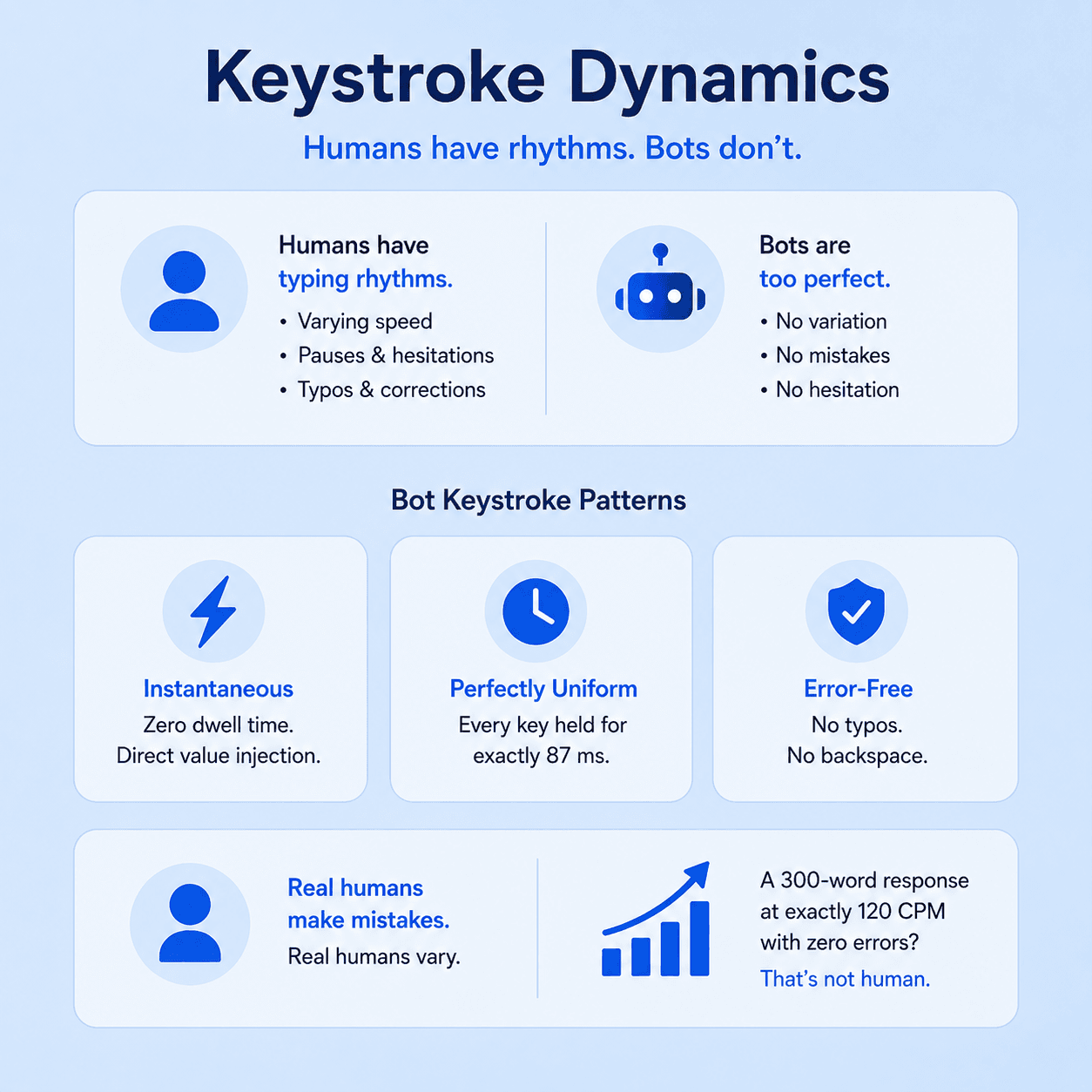
For teams that want to go deeper, keystroke tracking adds another layer.
Humans have typing rhythms. Like fingerprints. Some keys are held longer than others. There are pauses between certain letter pairs. Speed increases on easy words and decreases on hard ones. Typos happen and get fixed with backspace
Bots do not do this. Their keystrokes fall into three categories:
- Instantaneous. Zero dwell time. Direct value injection.
- Perfectly uniform. Every key held for exactly eighty-seven milliseconds.
- Error-free. No typos. No backspace. No hesitation.
Real humans make mistakes. Real humans vary. Real humans do not type a three-hundred-word response at exactly one hundred twenty characters per minute with zero errors
What Teams Can Do This Week
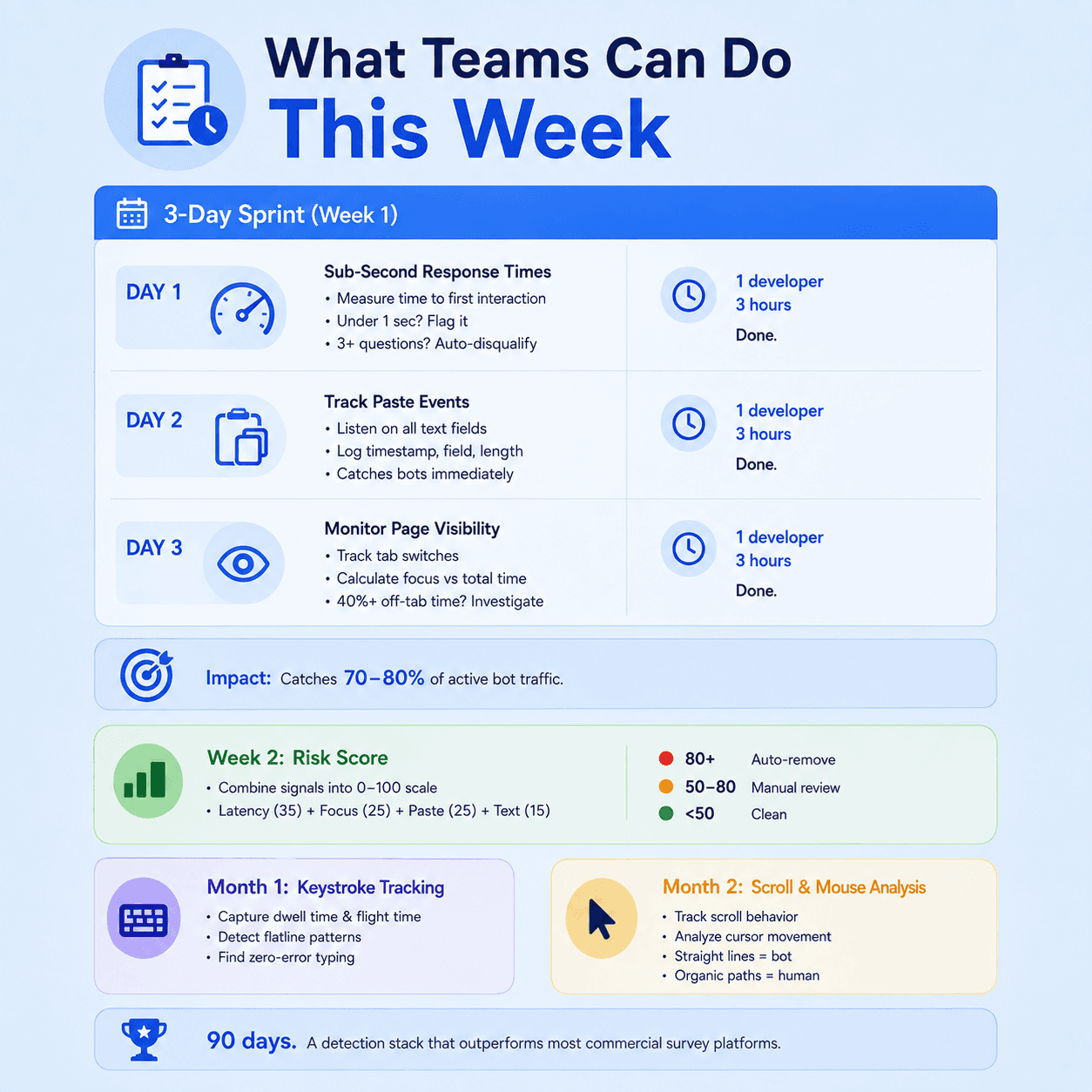
No six-month roadmap needed. Here is a practical three-day sprint.
Day one: Deploy the sub-second response times gate.
Add JavaScript that measures time from question render to first interaction. Under sub-second response times? Flag it. Happens on three or more questions? Auto-disqualify. One developer. Three hours. Done.
Day two: Track paste events.
Add paste event listeners to all text fields. Log the timestamp, the field, and the length of pasted content. The number of bots this catches immediately will be surprising.
Day three: Monitor page visibility
Use the Page Visibility API to track tab switches. Calculate active focus time versus total survey time. If someone spends forty percent of their survey time on another tab, that warrants investigation.
Those three things alone catch seventy to eighty percent of active bot traffic.
Week two: Build a simple risk score.
Combine signals into a zero-to-one-hundred scale. Latency violations: thirty-five points. Focus anomalies: twenty-five points. Paste events: twenty-five points. Text analysis legacy: fifteen points. Over eighty? Auto-remove. Fifty to eighty? Manual review. Under fifty? Clean.
Month one: Add keystroke tracking.
Capture dwell time and flight time on open-ended fields. Look for the flatline pattern. Look for zero-error typing. This catches more sophisticated operators.
Month two: Scroll and mouse path analysis.
Track whether people actually scroll to see questions before answering. Track cursor movement patterns. Straight lines to click targets indicate bot behavior. Organic, wandering paths indicate human behavior.
That is ninety days. By the end, the detection stack will outperform most commercial survey platforms.
Ethics and Compliance
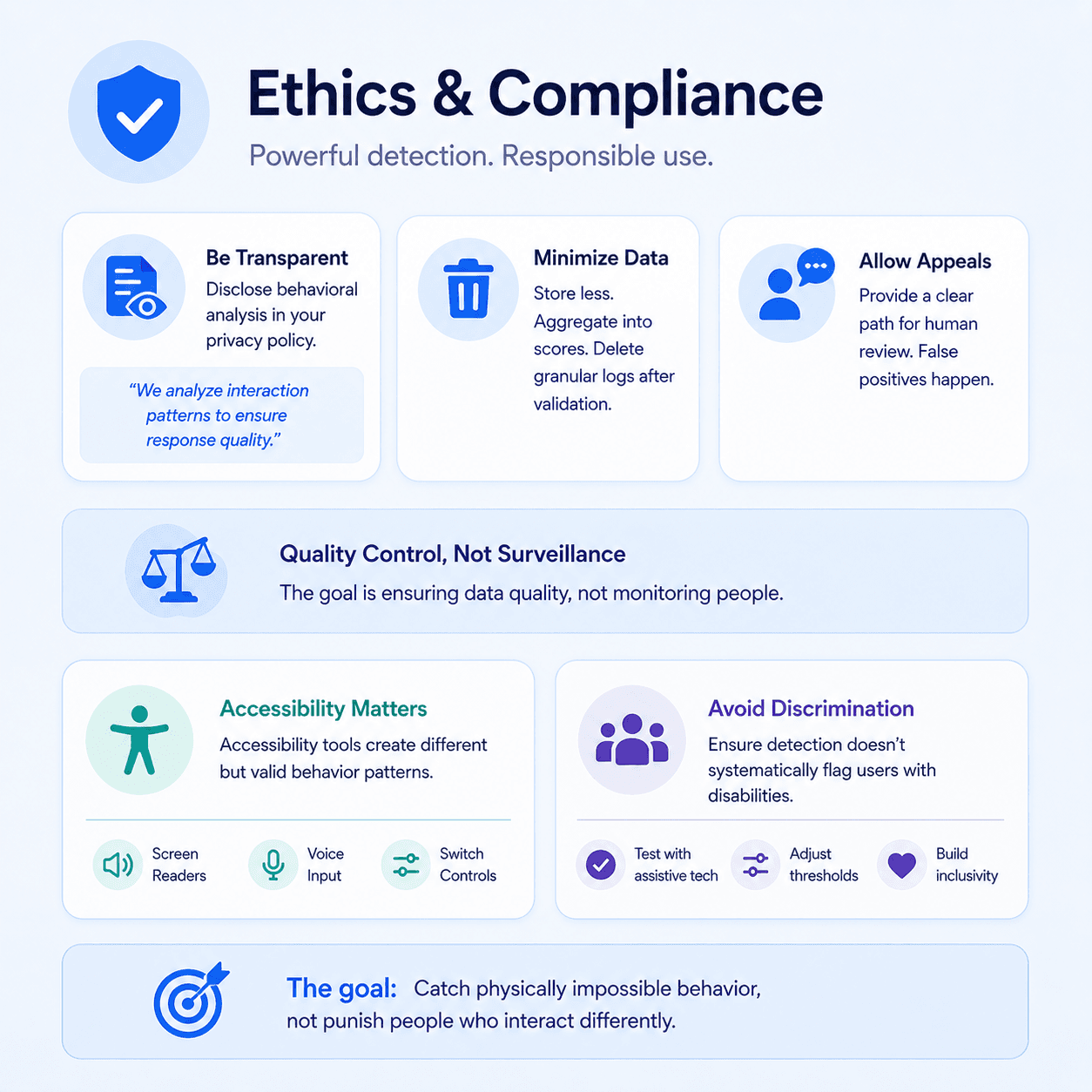
Behavioral tracking is powerful and must be used responsibly.
Disclose it. Include it in the privacy policy. "We analyze interaction patterns to ensure response quality." That is sufficient. Transparency builds trust.
Do not store raw behavioral data indefinitely. Aggregate into scores. Delete granular logs after validation.
This is quality control, not surveillance.
Allow appeals. If someone gets flagged, provide a path to human review. False positives happen. Accessibility tools create different but valid behavior patterns. Screen readers, voice input, switch controls: these are real users, not bots. Build inclusivity into the model from day one.
Avoid discrimination. Ensure detection does not systematically flag users with disabilities. Test with assistive technologies. Adjust thresholds. The goal is catching physically impossible behavior, not punishing people who interact differently.
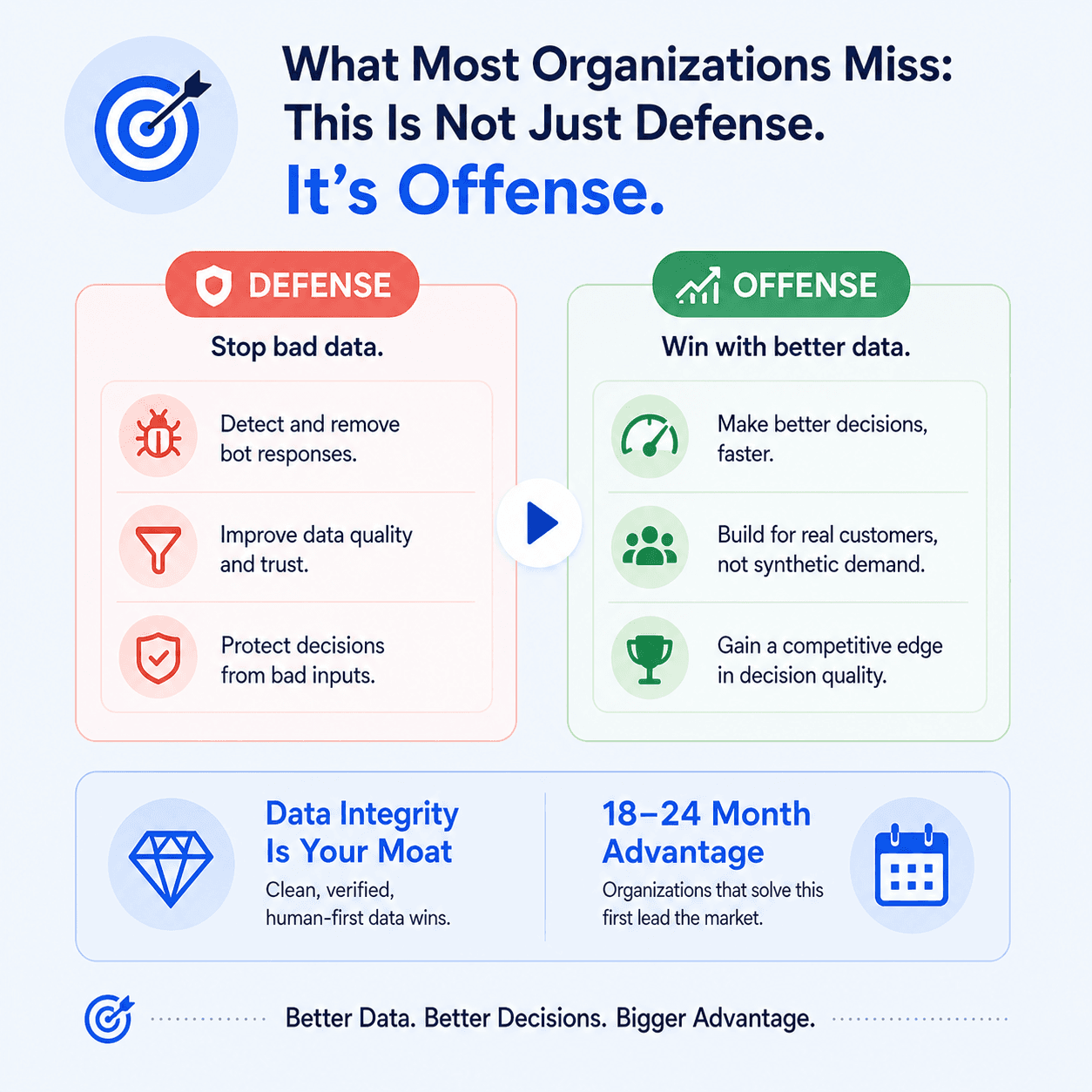
Here is what most organizations miss: this is not just defense. It is offense.
“The survey industry is at an inflection point. Text analysis had a good run. It caught a lot of bad actors. But 2026 is different. ”