An objective, product-level comparison of eight fraud detection tools evaluated on detection latency, GDPR & ISO 20252 compliance posture, and layered detection architecture.
Survey fraud has stopped being a fringe nuisance that shows up as a few speeders in your data table. In 2026, it is a structural cost line in every market research budget. Bots, click-farms, professional respondents running multiple panel identities, and increasingly convincing AI-generated open-ends are now routine features of online sampling and industry estimates consistently put the share of contaminated completes somewhere between 15% and 40%, depending on the vertical, incidence rate, and length of field time.
That has created a genuine software category: survey fraud detection software. Not “data cleaning,” not “panel quality,” but purpose-built systems that sit in the respondent journey and make a real-time call on whether the person on the other end of the link is who and what they claim to be.
This roundup is an objective, product-level comparison, not a company ranking. Two vendors can share a parent company, or the same vendor can offer three different products with three different fraud philosophies. What matters to a research operations lead is the product you actually integrate, and how it performs on three dimensions that determine real-world outcomes
- Latency - how early in the respondent journey fraud is caught (pre-survey vs. mid-survey vs. post-hoc cleaning)
- Compliance posture - how the product handles GDPR-regulated personal data and whether it supports ISO 20252-aligned quality documentation
- Layered detection architecture - whether the product relies on a single signal (like IP checks) or combines device, behavioral, biometric, and network-level signals into a defense-in-depth model
Why latency is the metric everyone underrates
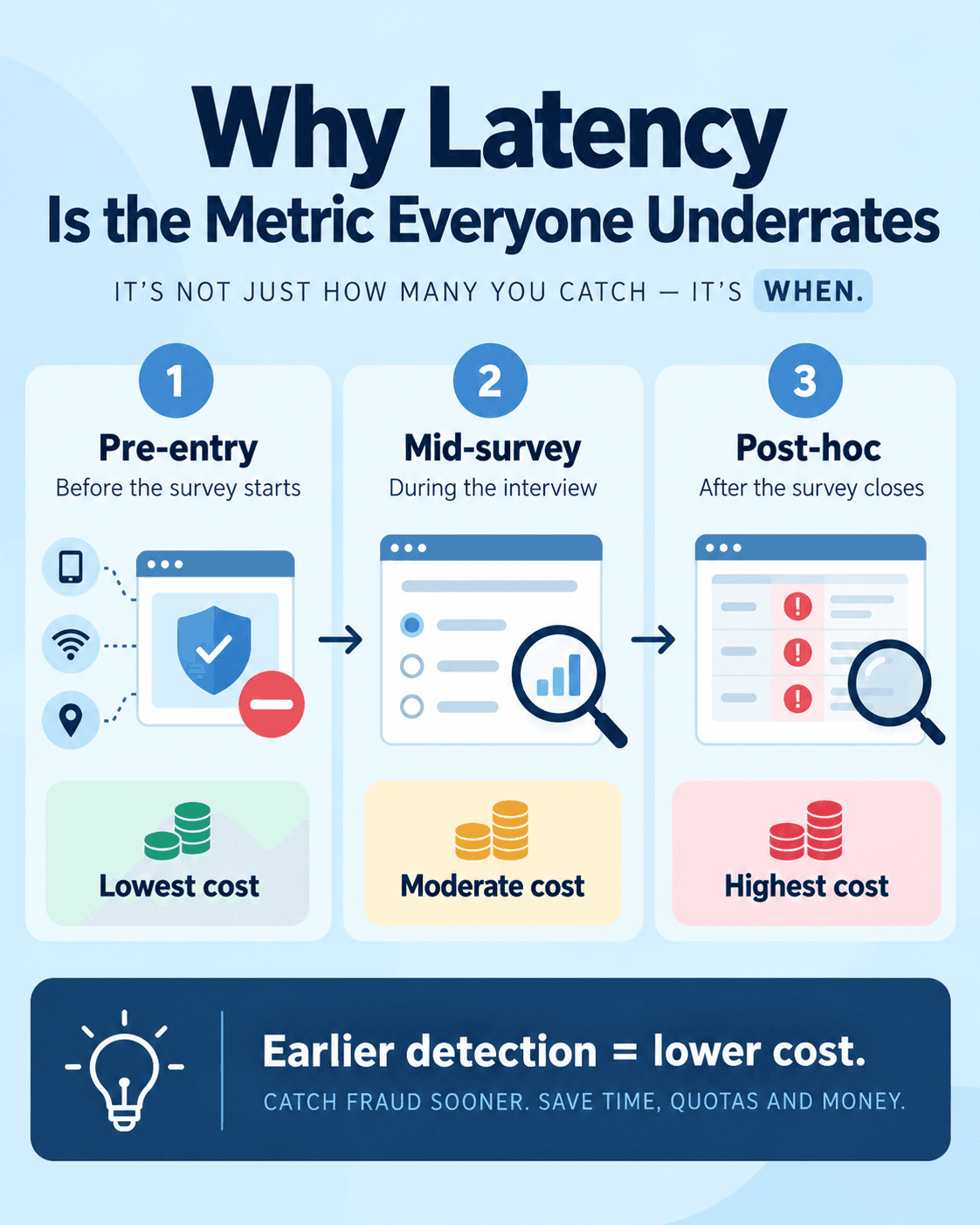
Most buyers evaluate fraud detection tools on catch rate , how many bad completes did the tool flag? That's the wrong first question. The right first question is: at what point in the pipeline did it catch them?
There are three broad latency tiers in the market today:
- Pre-entry (real-time, before the first question loads): The tool scores device, network, and behavioral signals before a respondent ever sees survey content. Fraudulent traffic is blocked or redirected before incentive cost, quota space, or interviewer time is spent on it.
- Mid-survey (in-flight, during the interview): The tool monitors response patterns, timing, and text quality as the respondent progresses, and can terminate or flag a session before completion.
- Post-hoc (after the survey closes): The tool or more often, a manual QA process reviews completed data and removes suspect rows from the dataset, after incentives and quotas have already been consumed
Post-hoc cleaning is still the default at a lot of agencies, largely because it doesn't require changing survey infrastructure. But it is the most expensive tier by a wide margin: you've already paid the incentive, already burned the quota cell, and if the field period has closed, re-fielding replacements costs both time and money. A tool that pushes detection earlier in the journey directly reduces cost per clean complete, even if its raw catch-rate number looks similar to a post-hoc tool on paper.
Ask vendors directly: “At what point in the respondent flow does your system make its first fraud decision?” The honest answer separates prevention products from cleanup products.
Why compliance (GDPR and ISO 20252) belongs in a fraud detection evaluation
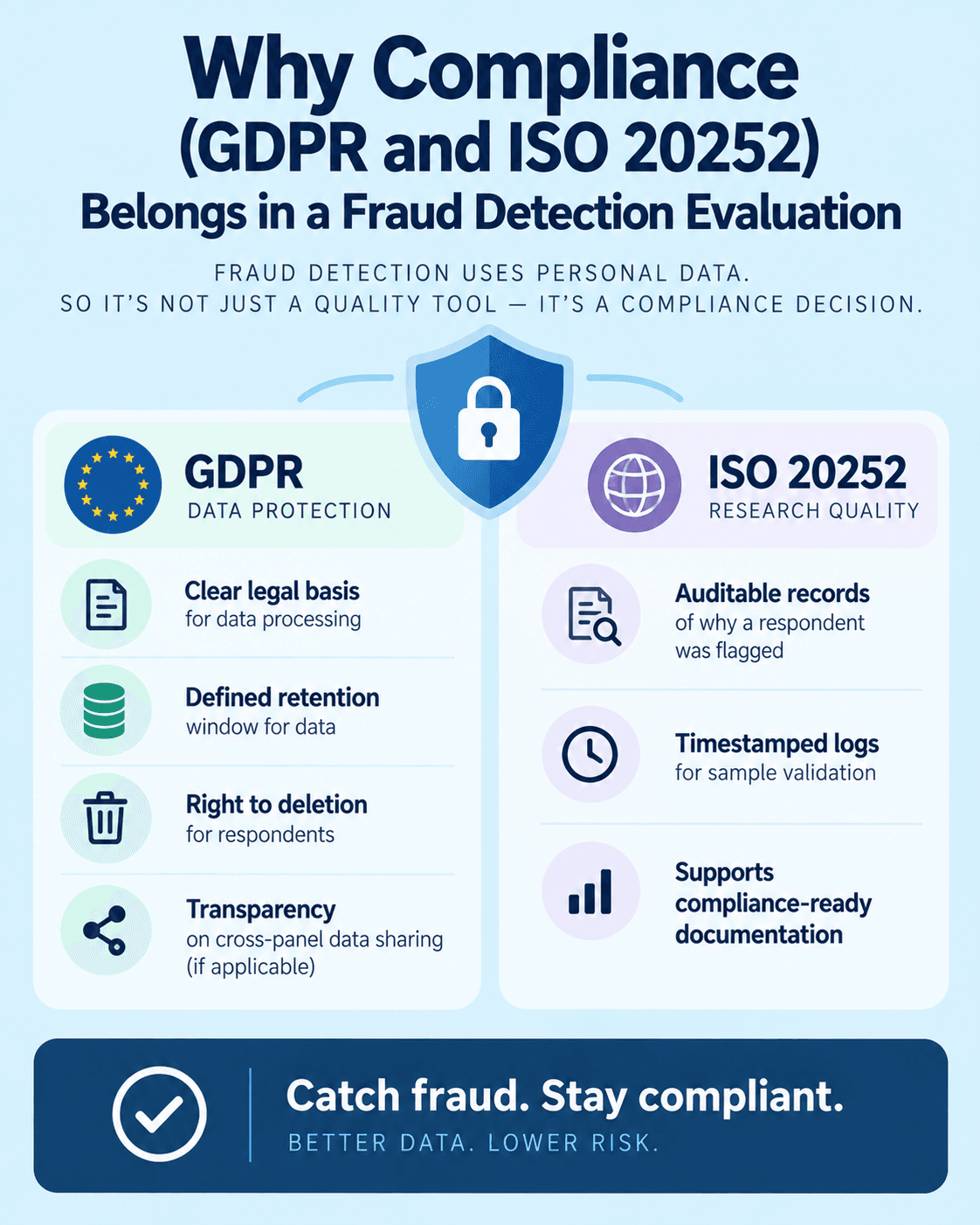
Fraud detection inherently involves processing personal data device identifiers, IP addresses, behavioral biometrics, and in some products, facial verification via selfie. That means every serious buyer in the EU/UK, or working with EU/UK panels, needs to evaluate these tools as data processors, not just as quality tools.
Two compliance dimensions matter:
GDPR posture. Does the vendor publish a clear legal basis for processing device and biometric signals? Is there a documented data retention window for fingerprinting data, and can a respondent request deletion? Products that fingerprint across panels (a “known bad actor” cross-panel registry) raise additional questions about data-sharing agreements between competing sample providers — worth asking about directly if you operate in regulated markets.
ISO 20252 alignment. ISO 20252 is the market research and social research industry's process-quality standard, and while it doesn't certify software directly, it does require agencies to document sample validation and data quality procedures. A fraud detection product that produces an auditable, timestamped log of why a respondent was flagged or excluded makes ISO 20252 documentation dramatically easier. A product that only gives you a final “clean” or “dirty” label, with no audit trail, pushes that documentation burden back onto your ops team.
In practice, this means the comparison isn't just “does the tool catch fraud” but “does the tool produce complianceready evidence of catching fraud.” That's a meaningfully different bar, and it's one that several legacy tools built years before GDPR enforcement tightened still don't clear well.
Why “layered” matters more than any single feature
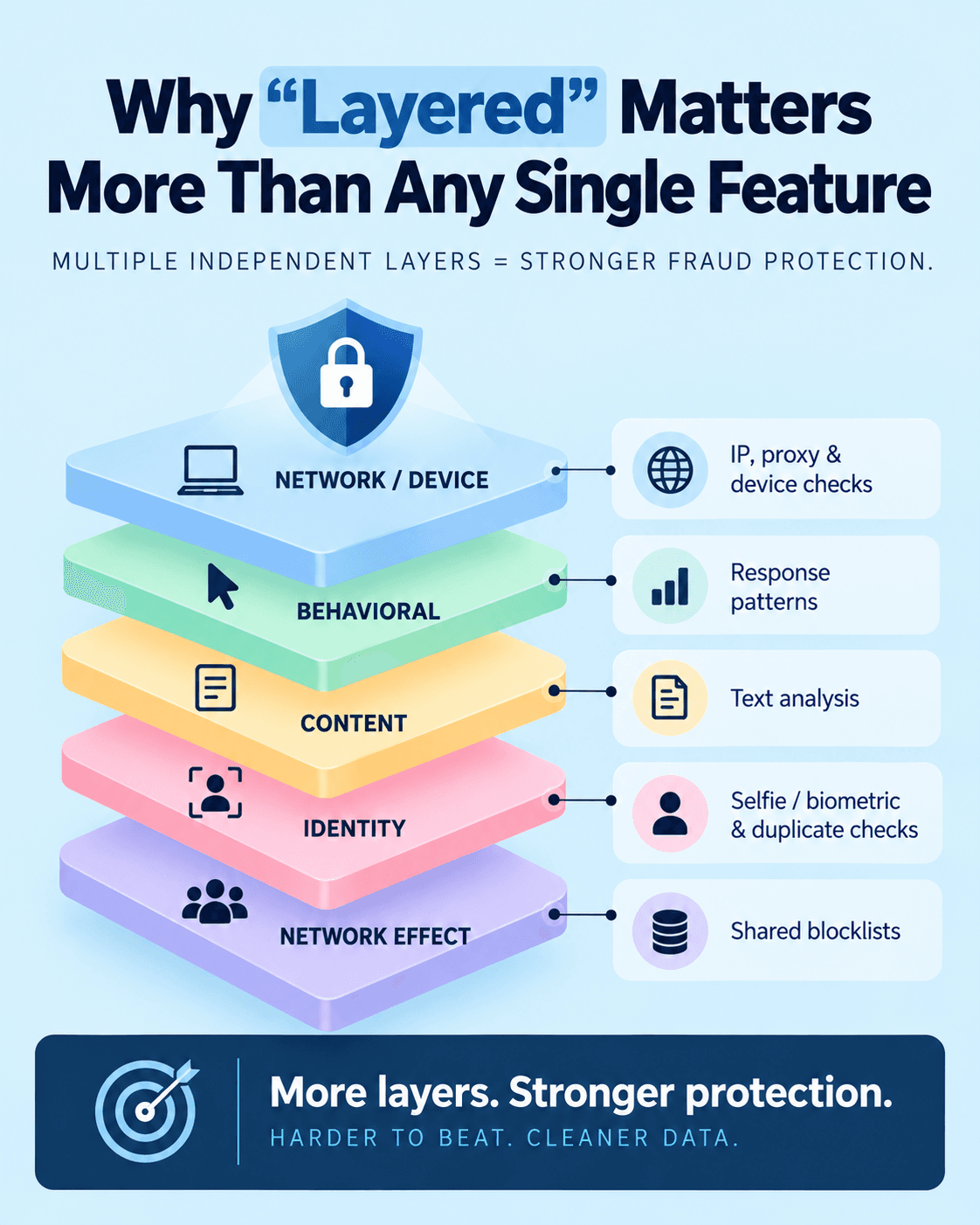
Single-signal fraud detection is easy to defeat. IP-only checks are beaten by residential proxies. Speeding checks are beaten by scripted bots with randomized timing. Device fingerprinting alone is beaten by device farms and emulators. This is why every credible product on the market today markets itself as “layered” or “multi-layered” but the number and independence of layers varies a lot.
A genuinely layered architecture typically stacks:
- Network/device layer -IP reputation, proxy/VPN/datacenter detection, device fingerprinting
- Behavioral layer - mouse movement, typing cadence, response timing distributions, straightlining detection
- Content layer - open-end text analysis for AI-generated or copy-pasted responses
- Identity layer - biometric or selfie-based verification, cross-panel duplicate registries
- Network-effect layer - shared blocklists or “no-fly” registries that persist a bad actor's flag across projects and sometimes across competing sample sources
The more of these layers a product runs independently (rather than as one signal feeding a single score), the harder it is for a sophisticated fraud ring to beat all of them simultaneously create which is exactly what organized click-farms are now optimized to do.
The product comparison
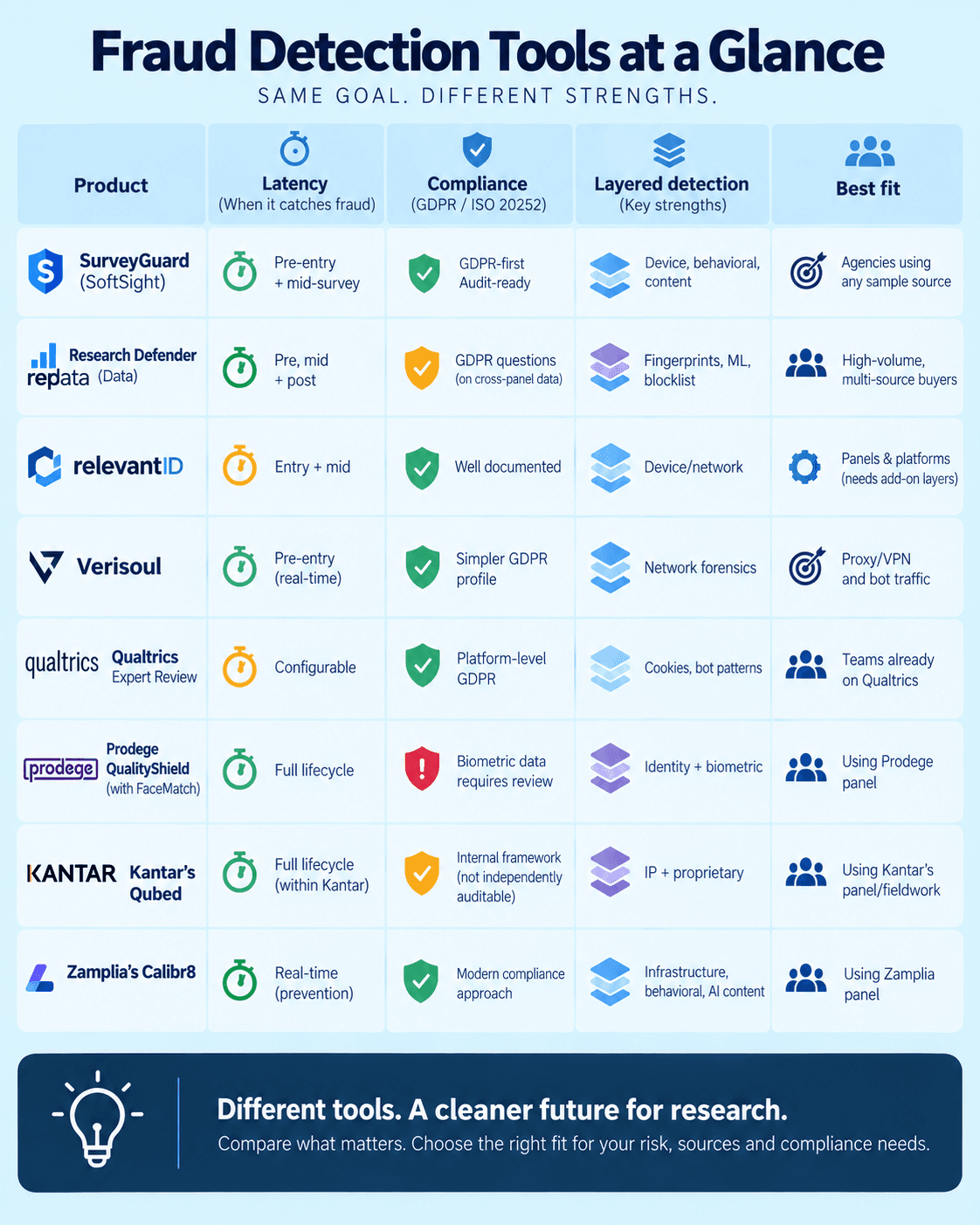
SurveyGuard (SoftSight)
SurveyGuard is SoftSight's fraud detection layer, built specifically for agencies and insight teams who want prevention-first architecture without needing to switch panel providers. It's designed to sit in front of any survey link whether the sample comes from a proprietary panel, a river source, or a programmatic marketplace rather than being locked to one panel's respondent pool.
- Latency: Pre-entry and mid-survey. SurveyGuard scores device, network, and behavioral signals before survey content loads, then continues monitoring through completion, so it functions as prevention rather than after-the-fact cleanup.
- Compliance: Built with GDPR-aligned data handling as a first-class requirement rather than a retrofit, including defined retention windows for fingerprinting data. Every flag SurveyGuard raises comes with a timestamped, exportable reason code, designed to slot directly into ISO 20252 sample validation documentation.
- Layered detection: Combines device/network fingerprinting, behavioral pattern analysis, and open-end content screening in independent scoring layers rather than a single blended score, so a respondent has to defeat multiple detection methods at once to pass through undetected.
- Best fit: Agencies and in-house insight teams that want a fraud layer they can attach to any sample source, with an audit trail built for compliance-heavy client work.
Research Defender (Rep Data)
Research Defender is one of the most established standalone fraud detection products, built around Rep Data's visibility into a very large volume of survey entrants across hundreds of sample sources.
- Latency: Multi-stage — Rep Data describes it as scoring respondents before, during, and after survey completion across a large number of individual risk signals.
- Compliance: As an aggregator with visibility across many sample sources, Rep Data's cross-panel duplicate registry (“No-Fly List”) raises the most interesting GDPR question of any product in this category: it depends on data-sharing arrangements between otherwise-competing sample providers, so EU/UK buyers should ask directly how that registry handles data subject deletion requests
- Layered detection: Strong -combines fingerprinting, a large bank of scored risk criteria, and a machinelearning layer trained on live reconciliation data from active projects, plus the industry-wide blocklist layer.
- Best fit: Buyers running high sample volume across many different panel and marketplace sources who want cross-source deduplication as the core value proposition.
RelevantID
RelevantID pioneered device fingerprinting for survey deduplication and remains one of the most widely licensed underlying technologies in the space , many panel providers embed it rather than building fingerprinting inhouse
- RelevantID pioneered device fingerprinting for survey deduplication and remains one of the most widely licensed underlying technologies in the space — many panel providers embed it rather than building fingerprinting inhouse
- Compliance: As a widely embedded, mature product, its data handling practices are well documented, though buyers should confirm how the underlying fingerprinting data is retained by whichever panel or platform has licensed it, since practices can vary by implementation
- Layered detection: Solid on the device/network layer specifically, but as a licensed component it typically needs to be paired with behavioral or content-layer tools by the platform that implements it, rather than delivering the full stack independently
- Best fit: Platforms and panels that want a proven fingerprinting engine to build additional layers on top of, rather than agencies looking for a complete out-of-the-box solution.
Verisoul
Verisoul positions itself as a network-forensics-first product, focused on catching sophisticated proxy and bot traffic that simpler IP-checking tools miss.
- Latency: Pre-entry, real-time network analysis designed to block fraudulent sessions before they reach survey content.
- Compliance: Network-forensics-only tools generally process less biometric/personal data than facialverification products, which can simplify the GDPR conversation, though device-level signals still require a documented legal basis.
- Layered detection: Deep on the network layer — including detection of residential proxies that defeat cruder datacenter-only IP checks — but buyers should confirm how it complements behavioral and content-layer checks, since network forensics alone won't catch a human fraud-farm worker using a clean residential connection.
- Best fit: Teams whose biggest fraud problem is sophisticated proxy/VPN traffic and bot networks rather than human click-farm labor.
Qualtrics Expert Review Fraud Detection
Qualtrics bundles fraud detection directly into its survey platform rather than selling it as a standalone product, which makes it the most accessible option for teams already building surveys in Qualtrics.
- Latency: Configurable bot detection and a “prevent multiple submissions” cookie-based check run at entry, while duplicate flagging can trigger during the session; but flagged responses are generally reviewed and actioned by the researcher rather than auto-blocked by default.
- Compliance: As a built-in platform feature, GDPR handling follows Qualtrics' broader platform-level data processing agreements, which is convenient for existing customers but gives less standalone auditability for ISO 20252 documentation than a purpose-built fraud product.
- Layered detection: Lighter than the dedicated fraud products above — primarily cookie-based duplicate detection and bot pattern recognition, without the biometric, cross-panel, or advanced behavioral layers that specialist tools offer
- Best fit: Teams already standardized on Qualtrics who need baseline fraud controls without adding a new vendor, rather than teams with high-fraud-risk sample sources.
Prodege QualityShield (with FaceMatch)
Prodege's QualityShield is a panel-native fraud system, built into the Prodege/Pollfish respondent pool, and notable for including a selfie-based biometric verification layer (FaceMatch) that many competitors don't offer
- Latency: Full-lifecycle — since Prodege owns the panel, fraud checks run from recruitment and registration all the way through survey completion, not just at survey entry.
- Compliance: Facial verification raises the most significant GDPR biometric-data questions of any product here; buyers should specifically request Prodege's legal basis and retention policy for FaceMatch data before using it with EU respondents.
- Layered detection: Very strong specifically because it's panel-native — continuous identity monitoring across the respondent lifecycle, not just point-in-time checks, plus the biometric layer as an additional signal most tools lack.
- Best fit: Buyers sourcing sample directly from Prodege's own panel who want the deepest identity verification available, and who are comfortable with the added biometric compliance review that entails.
Kantar's Qubed
Qubed is Kantar's proprietary fraud detection system, used internally across Kantar's own panel and fieldwork rather than sold as a standalone licensed product to third parties
- Latency: Full-lifecycle within Kantar's own panel ecosystem, similar in structure to other panel-native systems.
- Compliance: Governed under Kantar's own data processing framework; not independently auditable by outside buyers the way a standalone product's documentation would be, since it isn't offered as a separable, licensable product.
- Layered detection: Kantar describes combining IP-based session controls with multiple additional proprietary techniques, though because it's closed and used only within Kantar's own fieldwork, external buyers can't directly compare its layer count against open-market products.
- Best fit: Buyers whose fieldwork already runs through Kantar's own panel and fieldwork services, rather than buyers looking for a portable, cross-source fraud detection layer.
Zamplia's Calibr8
Calibr8 is Zamplia's fraud detection system, explicitly positioned around the “prevention over cleanup” argument — a philosophy shared with SurveyGuard and worth comparing directly.
- Latency: Real-time, designed to intervene during fieldwork rather than at post-collection cleanup, in line with the broader 2026 shift away from post-hoc data cleaning.
- Compliance: As a newer entrant built around a 2026-era prevention model, Calibr8's documentation reflects more recent regulatory expectations than some legacy tools, though as with any vendor, buyers should request specifics on retention and legal basis for behavioral/technical signal storage.
- Layered detection: Combines infrastructure-level validation, behavioral analysis, and AI-powered content review into what Zamplia describes as a hybrid scoring model
- Best fit: Teams sourcing sample through Zamplia's own panel network who want a prevention-first system bundled with the sample itself, rather than a fraud layer that attaches to sample from any source.
How to actually run this evaluation
A few practical steps for anyone shortlisting from this list:
- Ask for a latency diagram, not a feature list. Have the vendor show you exactly where in the respondent flow their first fraud decision happens. If they can't produce this quickly, it's a sign the product is oriented toward reporting rather than prevention.
- Request a sample compliance packet. For GDPR, ask for their data retention schedule and legal basis documentation specifically for device/behavioral/biometric signals — not just their general privacy policy. For ISO 20252, ask whether flagged-respondent logs export in a format your QA team can attach to project documentation.
- Run a side-by-side pilot on the same sample source. Because “layered” is a marketing word as much as a technical one, the only reliable way to compare catch rates and false-positive rates is to run two tools against the same fielded project and compare flagged respondent overlap
- . Separate the panel from the fraud tool. If a vendor bundles fraud detection with their own panel, be clear-eyed that you're evaluating two things at once — sample quality and fraud tooling — and that the fraud tool may not be available if you ever switch sample providers.
Where this leaves buyers in 2026
The direction of the market is unambiguous: real-time, pre-entry prevention is displacing post-hoc cleaning as the baseline expectation, and compliance documentation GDPR retention practices and ISO 20252-ready audit trails is becoming as much a purchase criterion as raw catch rate. Products that only offer one of these (strong catch rate but no audit trail, or panel-native depth but no portability across sample sources) are increasingly being paired with a second tool to cover the gap, which adds cost and integration overhead.
For agencies and insight teams that want prevention-first detection, GDPR-aligned data handling, and an audit trail built for ISO 20252 documentation — without being locked into a single panel's respondent pool — SurveyGuard by SoftSight is built specifically around that combination.