In the world of healthcare market research, there is a recurring fiction that plays out during the bidding phase of almost every complex project. A fieldwork requester puts out an RFP for a quantitative survey or a qualitative interview stream targeting 150 to 200 specialized rheumatology nurses across a specific region. Within forty-eight hours, an enthusiastic account manager from a single online panel provider responds with a glittering assurance: "We have over 500 rheumatology nurses profiled in our proprietary panel. Feasibility is 100% covered."
Experienced operations directors know exactly what happens next. The project launches. Week one yields twelve completes. Week two yields four. By week three, the project stalls entirely, the vendor blames an unexpectedly low incidence rate, and the timeline crumbles.
The harsh reality of healthcare sampling is simple: no single market research panel has 200 active, verified, compliant rheumatology nurses ready to take a survey. Relying on a single supplier for rare, highly specialized medical audiences is a mathematical impossibility.
The harsh reality of healthcare sampling is simple: no single market research panel has 200 active, verified, compliant rheumatology nurses ready to take a survey. Relying on a single supplier for rare, highly specialized medical audiences is a mathematical impossibility.
The Global Workforce Reality: The Top of the Funnel
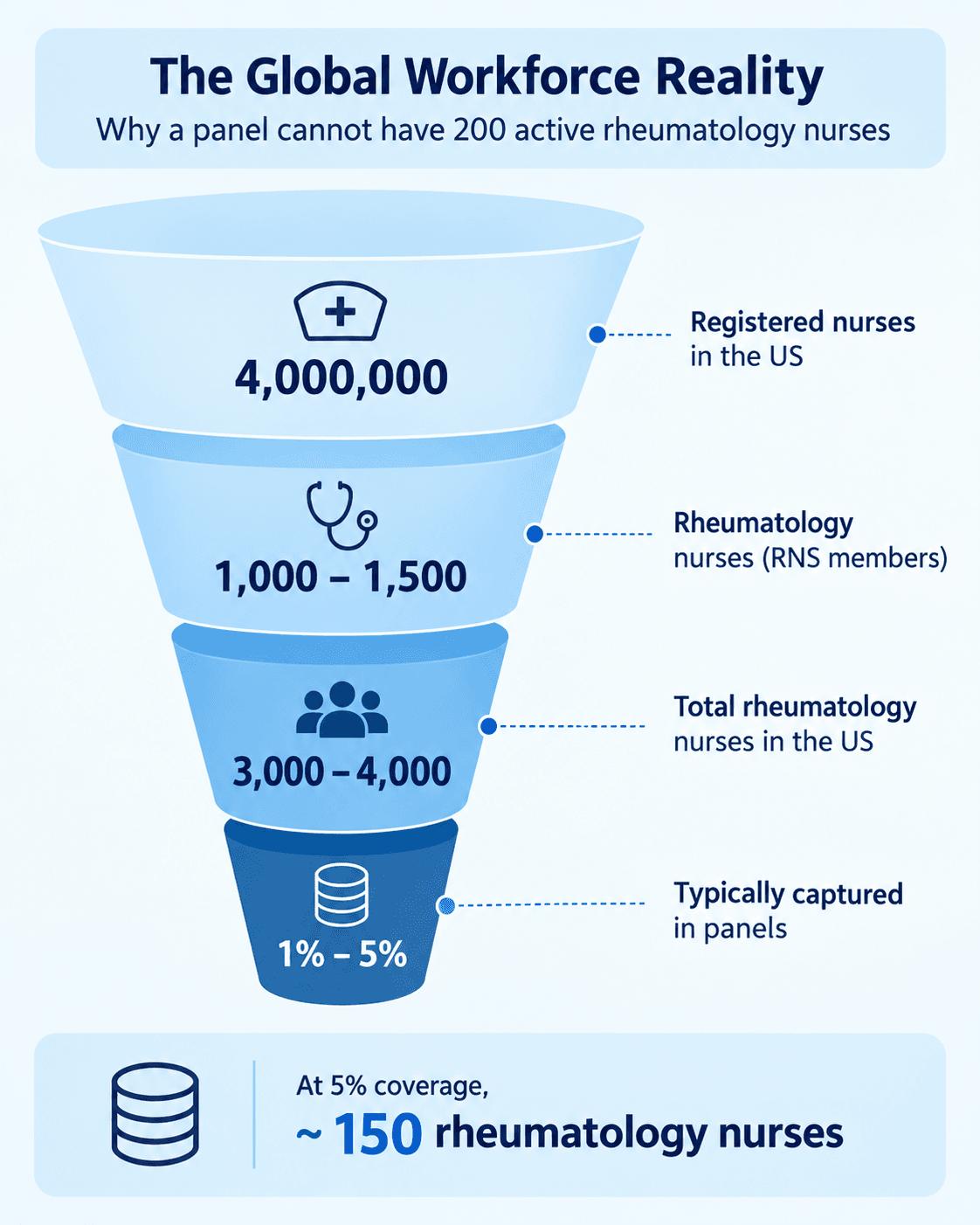
To understand why a panel cannot possess 200 active rheumatology nurses, we must first look at the total universe of these professionals. Market research panels do not exist in a vacuum; they are microscopic subsets of the actual nursing workforce.
- Total Registered Nurses: There are roughly 4 million registered nurses (RNs) in the United States.
- Rheumatology Specialization: Of those, only a tiny fraction specialize in rheumatology. The Rheumatology Nurses Society (RNS) typically maintains an active membership hovering between 1,000 and 1,500 professionals.
- Addressable Universe: Even if we account for non-member nurses practicing in the space, the total addressable universe of dedicated rheumatology nurses in the US rarely exceeds 3,000 to 4,000 individuals nationwide.
Now, consider the mechanics of market research panel recruitment. On average, even the most aggressive healthcare panels capture between 1% and 5% of a specific professional medical population into their opt-in databases. If a panel is exceptionally successful and captures 5% of a 3,000-person universe, its total database size for this niche is exactly 150 people.
The Illusion of Database Profiles (The 5x Over-Claim)
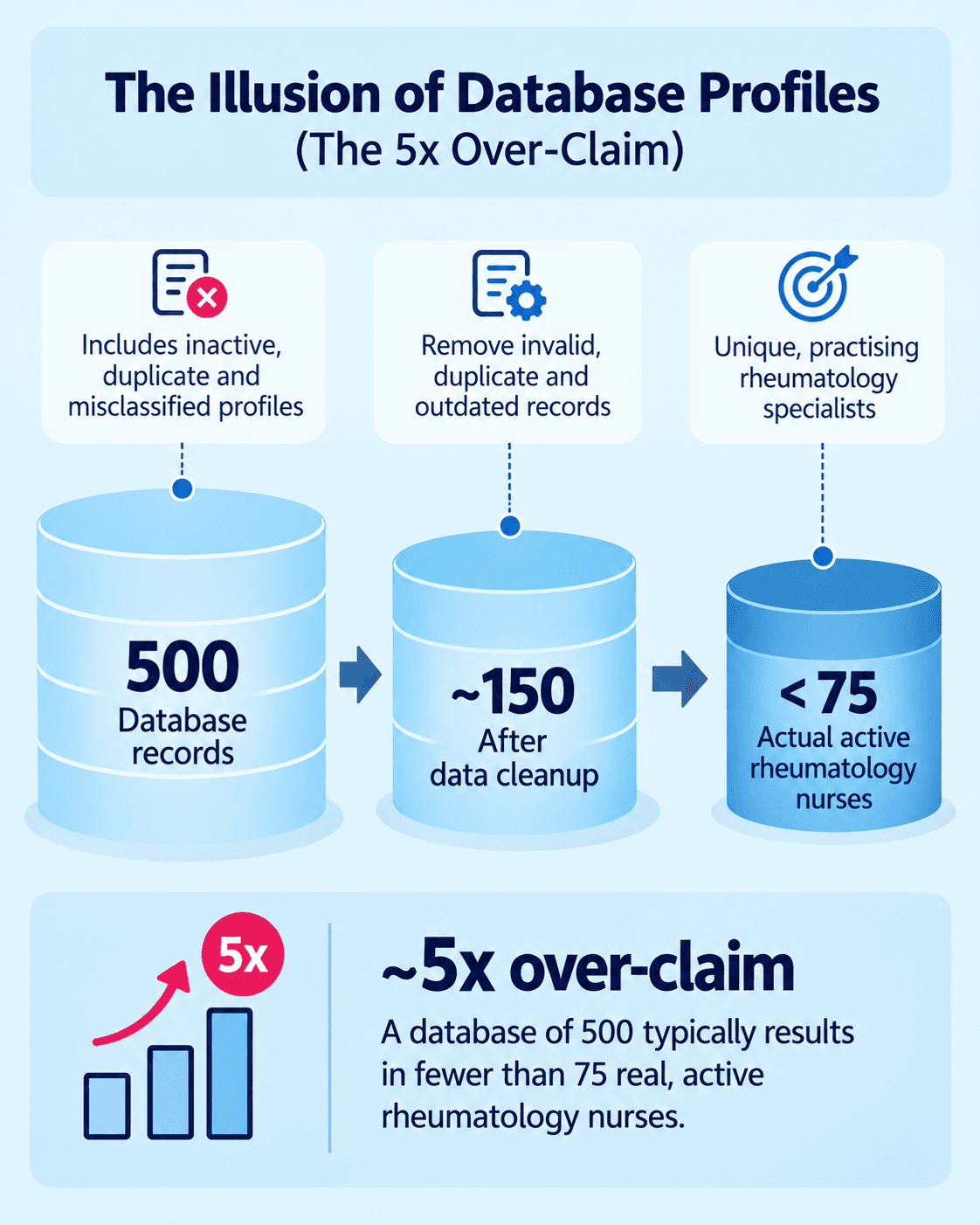
The numbers that sample providers present in biddings are almost always "database counts," not "active panelist counts." Database counts are subject to massive inflation due to poor data hygiene, self-reported profiling errors, and historical profiling decay.
The Misclassification Trap: When a nurse signs up for a research panel, they are typically presented with a multi-select menu of specialties. A general medical-surgical nurse who occasionally administers a biologic infusion for a rheumatoid arthritis patient will frequently check the box for "Rheumatology" alongside five other specialties like "Orthopedics," "Immunology," and "General Medicine." To the panel's automated query system, that nurse is now tallied as a rheumatology nurse.
When a vendor pulls a query for "Rheumatology Nurse," the system counts the dead accounts, the misclassified generalists, and the duplicate entries. A theoretical database of 500 records typically collapses into a true, unique pool of fewer than 75 actual, practicing rheumatology specialists. This is the 5x Over-Claim Inflation Factor.
The Math of Decay: The True Recruitment Funnel
To demonstrate the mathematical impossibility of single-panel sufficiency, let us trace a hypothetical project that requires 100 completed survey responses from rheumatology nurses, using a single vendor who claims a database of 300 target professionals.
| Funnel Stage | Drop/Loss Factor | Remaining Pool |
|---|---|---|
| Initial Claimed Database | Baseline starting query | 300 Records |
| Database Hygiene & Duplication Check | 50% Loss (Misclassified/Duplicated) | 150 Records |
| Email Reachability & Active Panelist Rate | 40% Loss (Inbound/Spam Filter) | 60 Records |
| Response Rate / Click-Through Rate | 25% Actual Yield (Time constraints) | 15 Records |
| Screener & Incidence Rate (IR) Filter | 60% Pass Rate (Hyper-clinical rules) | 9 Records |
| Abandonment / Data Quality Drops | 10% Drop out / Speeder flag | 8 Completes |
Why Sample Blending and Multi-Supplier Strategies Are Mandatory
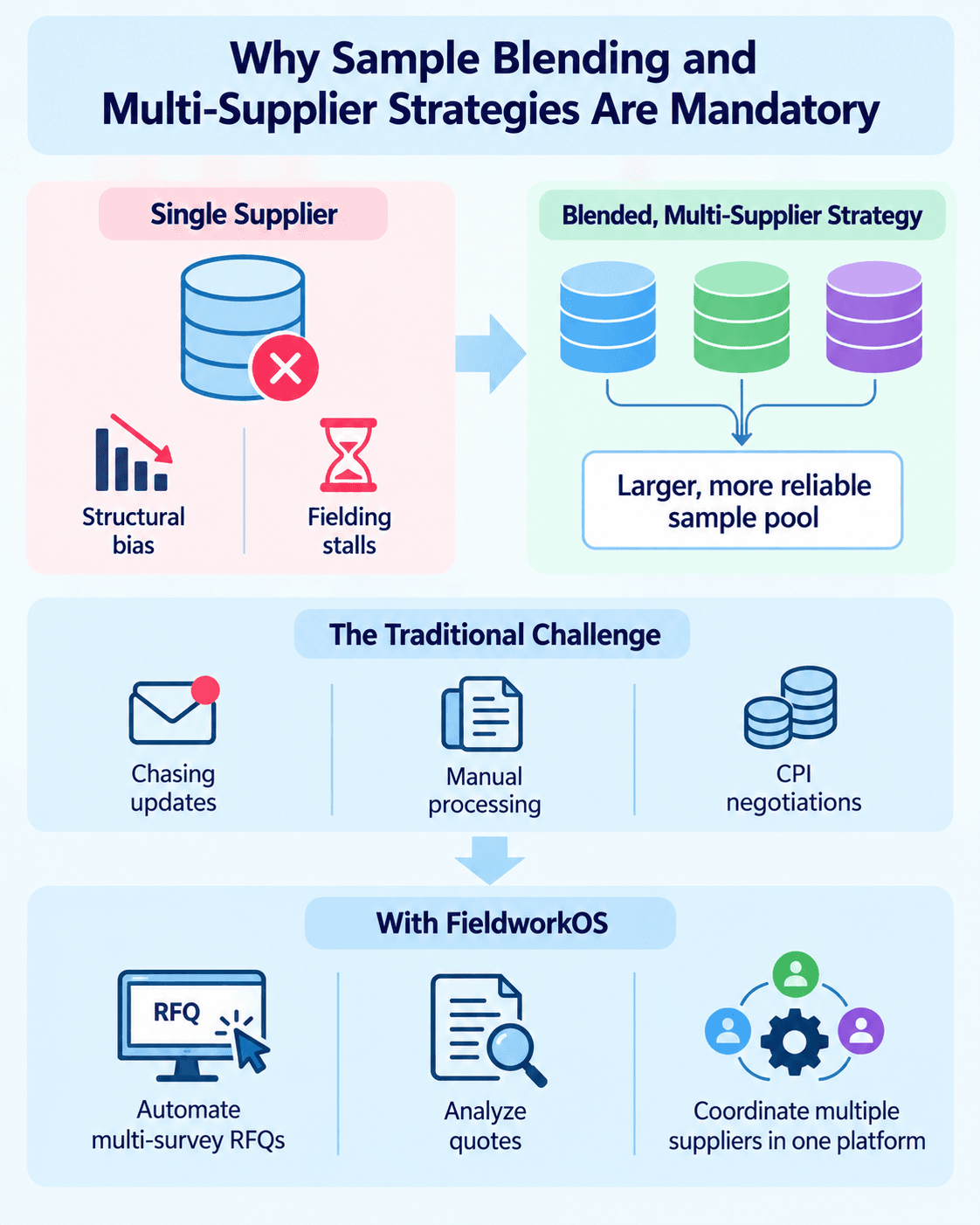
When a research project relies on a single sample provider for a rare audience, it exposes itself to structural sample bias and inevitable fielding stalls. To combat this, modern healthcare data collection must rely on a blended, multi-supplier sampling frame.
Managing a multi-supplier framework traditionally introduces immense administrative work—chasing updates, manual email processing, and blind cost-per-interview (CPI) negotiations. This overhead is exactly why SoftSight engineered FieldworkOS. Instead of orchestrating this chaos manually, insights teams use our dedicated execution platform to automate multi-survey RFQ distribution, intelligently analyze incoming quotes, and coordinate a symphony of independent suppliers within a single operational interface
Overcoming Sample Overlap and De-Duplication
The primary operational counter-argument to a multi-supplier strategy is the risk of respondent overlap. If a respondent is targeted across multiple vendor routes, it introduces duplicate data risk. Managing this requires strict independent verification handled at the infrastructure layer.
- National Provider Identifier (NPI) Gate: Requiring unique professional licensing registration tags to cross-reference entries in real time.
- Triple-Gate Fraud Protection: Deploying browser fingerprinting, network validation, and fraud monitors via the integrated SoftSight Platform infrastructure layer.
Blueprint for a Resilient Healthcare Fielding Strategy
To execute an international or large-scale quantitative study among rare audiences without missing deadlines, operations teams should adopt a programmatic approach to multi-sourcing.
| Supplier Type | Claimed Database | Empirical Response Rate | Data Quality Score | Quota Allocation |
|---|---|---|---|---|
| Vendor A (Mega-Panel) | 400 Records | Low (12%) | Medium | 25% allocation |
| Vendor B (CME Specialist) | 120 Records | High (45%) | Excellent | 50% allocation |
| Vendor C (Custom Outbound) | N/A (Direct Phone) | High Touch | Flawless | 25% allocation |
Conclusion: Empathy for the Funnel
The myth of the all-encompassing, single-source medical panel is born out of a desire for simplicity. Workforce constraints are real. Rheumatology nurses are busy, rare, and distributed unevenly across competitive data systems. Accepting the math of fragmented feasibility means moving past idealized database numbers and designing methodologies around real human behavior.
By building multi-supplier sampling frameworks, accounting for operational decay, and utilizing modern operational layers like SoftSight's FieldworkOS, researchers can move away from volatile fieldwork stalls and deliver predictable, high-integrity medical insights.