An operational decision guide for sample procurement, vendor management, and fieldwork optimization with SoftSight FieldworkOS.
As primary research scales within enterprise organizations, Research Operations (ResOps) teams face a highstakes challenge: procuring high-quality participant sample efficiently without blowing budgets, falling victim to fraudulent completes, or creating massive operational bottlenecks.
Historically, sample sourcing was straightforward, albeit slow and expensive. Research teams hired full-service agencies or traditional panel providers who managed sampling end-to-end behind closed doors. Today, the modern Research Operations landscape has undergone a dramatic transformation. The rise of programmatic marketplaces and panel aggregators has given ResOps teams direct access to millions of respondents at a fraction of the traditional cost.
However, speed and low cost come with distinct trade-offs. Programmatic marketplaces can expose surveys to variable panel quality and duplicate respondents. Conversely, traditional direct suppliers offer high compliance and verified targets but demand steep Cost Per Completes (CPCs), project minimums, and longer operational lead times.
To build a resilient procurement framework, ResOps leaders must move beyond binary choices. This guide breaks down the core strategy behind Marketplaces, Direct Suppliers, and Hybrid Models.
Deconstructing the Modern Sample Procurement Ecosystem
Understanding when to use each sourcing channel requires analyzing their operational profiles and supply dynamics.
Marketplace Models (Programmatic Aggregators)
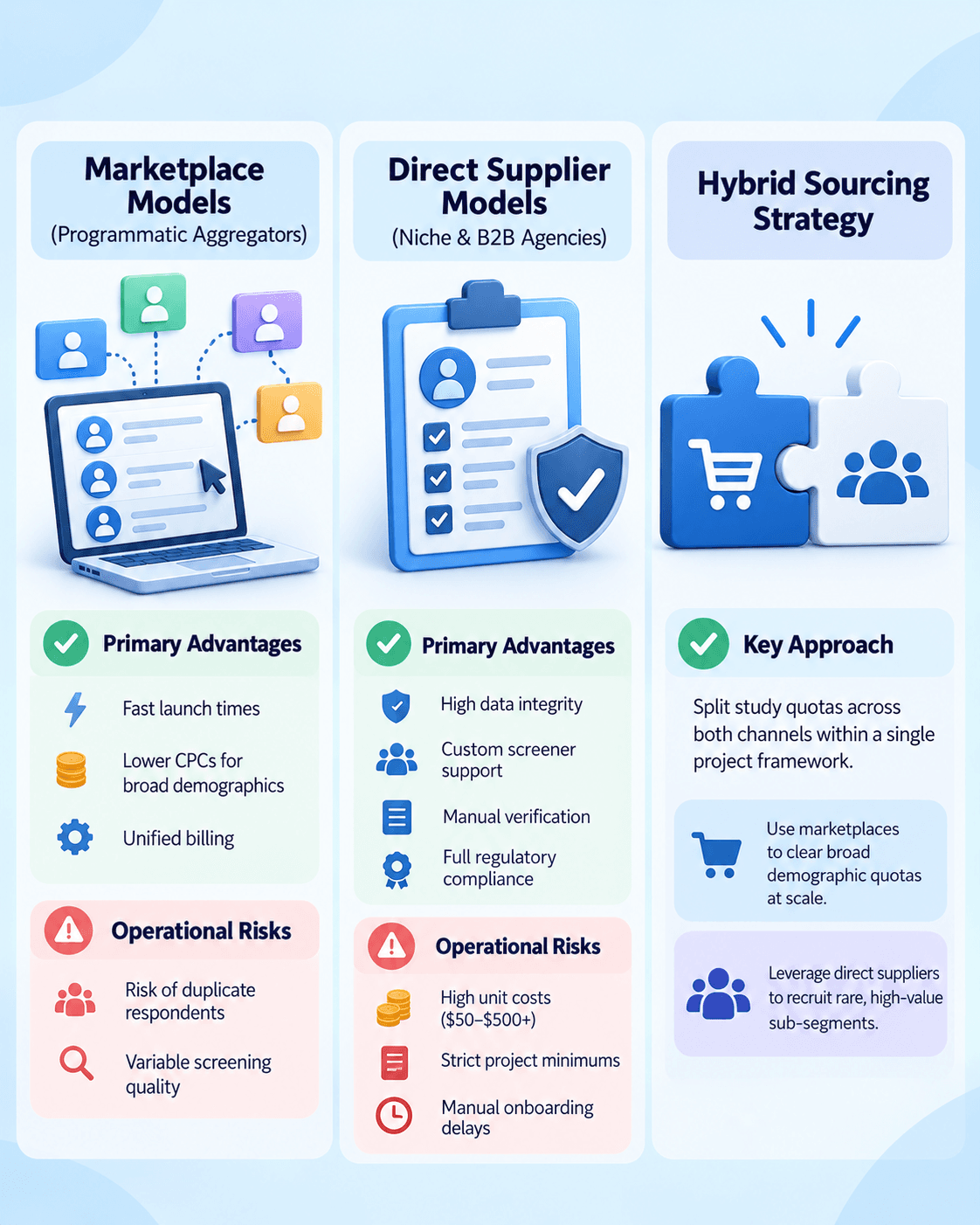
Marketplaces aggregate supply from dozens or hundreds of panel suppliers through automated exchanges. When a survey goes live, traffic is dynamically allocated across connected suppliers to fill quotas efficiently.
- Primary Advantages: Fast launch times, low Cost Per Completes (CPCs) for broad consumer demographics, and unified billing
- Operational Risks: Risk of duplicate respondents across sub-panels and variable screening quality.
Direct Supplier Models (Niche & B2B Agencies)
Direct suppliers manage proprietary, closed-loop respondent pools. Recruitment is tightly vetted against official registries (such as verifying corporate executives or healthcare professionals) and supported by dedicated project managers.
- Primary Advantages: High data integrity, custom screener support, manual participant verification, and full regulatory compliance.
- Operational Risks: High unit costs ($50–$500+ for specialized targets), strict project minimums, and manual onboarding delays.
Hybrid Sourcing Strategy
A hybrid approach splits study quotas across both channels within a single project framework using marketplaces to clear broad demographic quotas at scale, while leveraging direct suppliers to recruit rare, high-value sub-segments.
The ResOps Sourcing Decision Tree
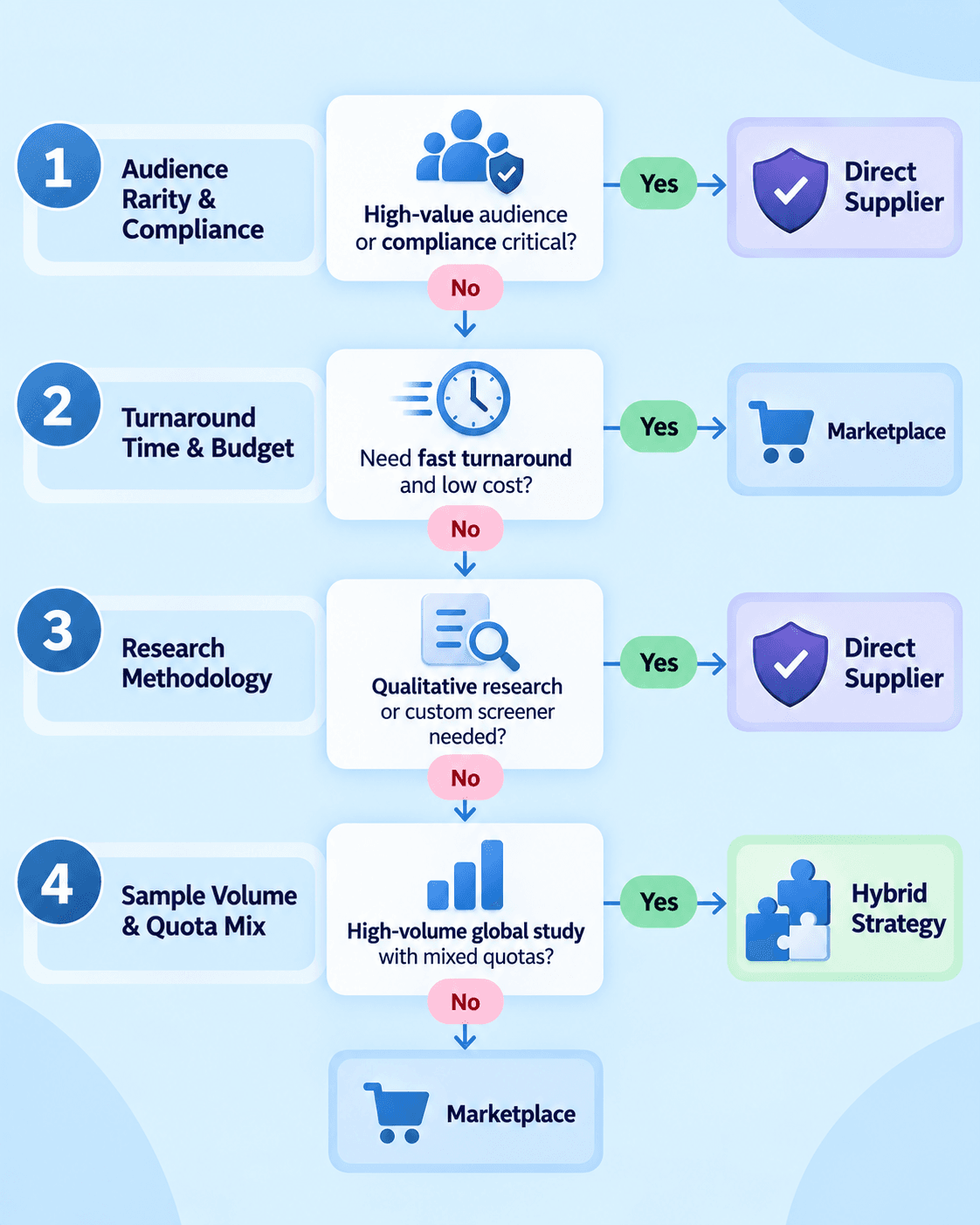
Use this 4-step framework to guide procurement decisions prior to contracting sample:
- Step 1: Evaluate Target Audience Rarity & Compliance Risk
Is the study recruiting high-value decision makers (e.g., Enterprise CISOs, Oncologists, C-suite executives) or requiring strict legal compliance?
➔ YES: Route to Direct Supplier for specialized recruitment.
➔ NO: Proceed to Step 2.
- Step 2: Evaluate Turnaround Time & Budget Constraints
YES: Route to Marketplace for low-cost, automated quota filling.
NO: Proceed to Step 3.
- Step 3: Evaluate Research Methodology
Does the study require qualitative depth interviews (IDIs), focus groups, or custom vendor-built screener logic?
➔ YES: Route to Direct Supplier .
➔ NO: Proceed to Step 4.
- Step 4: Evaluate Sample Volume & Quota Heterogeneity
Is this a high-volume global study spanning multiple geographies with split quotas between broad demographics and hard-to-fill subsegments?
➔ YES: Deploy Hybrid Strategy .
➔ NO: Route to Marketplace .
Where Fieldwork Gets Broken (And How FieldworkOS Solves It)
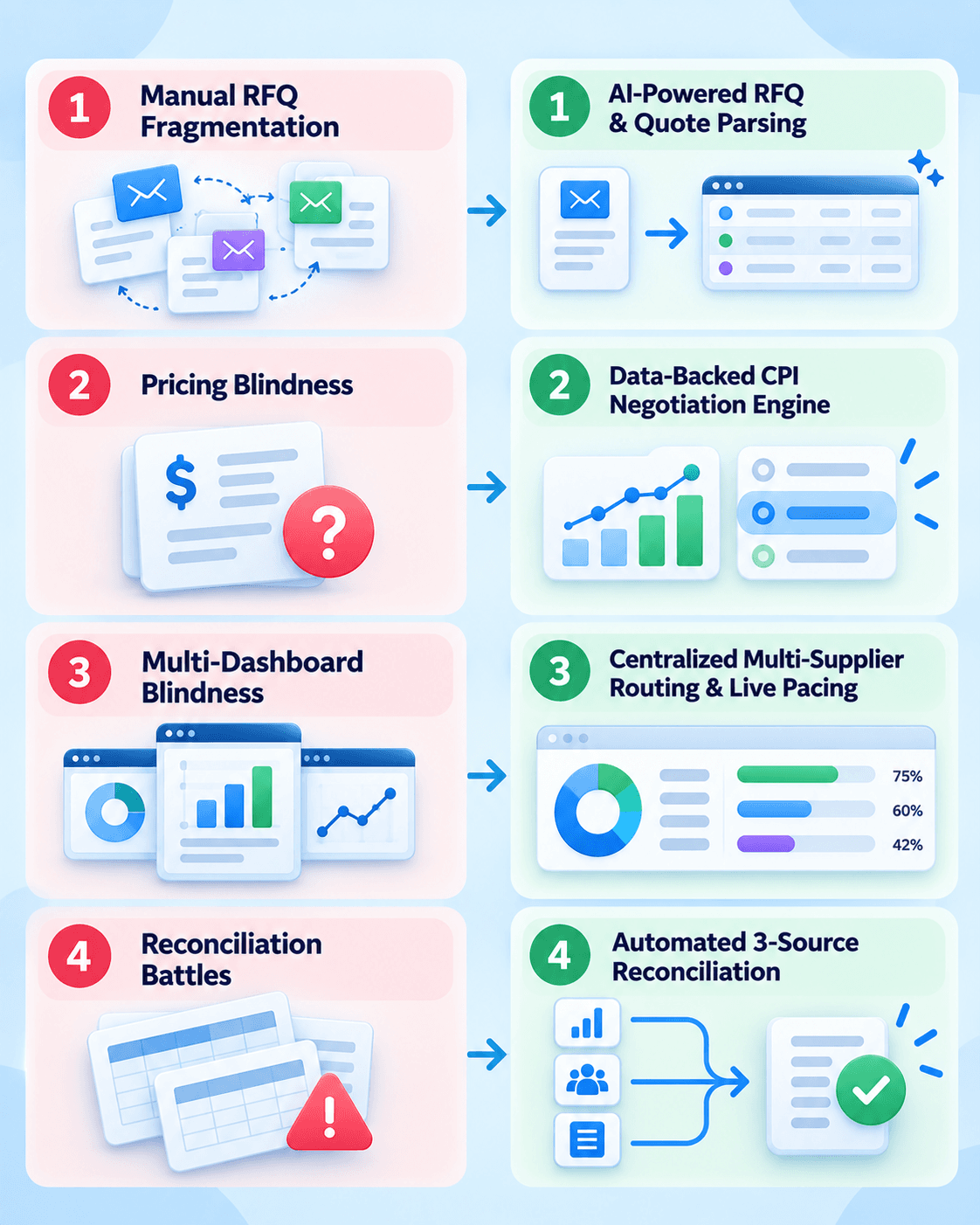
Executing multi-supplier or hybrid sourcing in theory is clean but in practice, market research fieldwork is an operational gauntlet. ResOps teams routinely spend up to 70% of project hours managing administrative friction rather than strategy:
- Manual RFQ Fragmentation: Sending separate RFQ emails to multiple suppliers, sifting through inconsistent spreadsheet formats, and manually calculating blended CPIs.
- Pricing Blindness: Accepting vendor pricing without market benchmarks or data-driven counter-offer frameworks.
- Multi-Dashboard Blindness: Logging into separate survey engines and supplier portals to manually track pacing, velocity, and quota bottlenecks.
- Reconciliation Battles: Spending days post-fieldwork fighting suppliers over dropouts, bad completes, and duplicate counts.
Transforming Sourcing Operations with SoftSight FieldworkOS
This operational breakdown is why modern ResOps teams build their workflows on FieldworkOS by SoftSight (softsight.io/products/ fieldwork-os/). FieldworkOS serves as the dedicated operational infrastructure for market research sample procurement and execution:
- AI-Powered RFQ & Quote Parsing: Automatically ingests vendor RFQ responses from email, extracting CPIs, sample capacities, and redirect links into a single comparison dashboard within seconds.
- Data-Backed CPI Negotiation Engine: Generates algorithmic counter-offers (Conservative, Balanced, or Aggressive) based on real-time market data and historical supplier flexibility.
- Centralized Multi-Supplier Routing & Live Pacing: Real-time monitoring of quota fills, supplier velocity, and incidence rate drops across both marketplaces and direct vendors in one view.
- Automated 3-Source Reconciliation: Reconciles completes and dispositions automatically between your survey platform (Decipher, Forsta, Qualtrics), supplier logs, and client records eliminating billing disputes entirely.
Vendor Governance Best Practices
Regardless of the sourcing model chosen, ResOps teams must maintain strong vendor governance:
- Enforce Quality Controls: Build honeypot questions, speeder traps (flagging completes completed too quickly), and straight-lining detectors into your survey setup.
- Establish Fraud Replacement Windows: Contractually mandate that suppliers replace flagged fraudulent completes free of charge within 7 to 10 business days post-fieldwork.
- Maintain Clean Lists: Track performance across vendors and actively block underperforming sub-panel sources while directing more volume to high-integrity partners.
Master Your Fieldwork Operations with SoftSight Pairing a clear sourcing decision tree with dedicated infrastructure like FieldworkOS allows research teams to reduce sample spend by up to 35%, reclaim 70% of operational time, and deliver rock-solid data quality.