A practical framework for evaluating sample partners beyond CPI based on fit, performance, quality, and total cost of ownership.
For market research agencies, brand strategy teams, and corporate insights divisions, sample procurement is often treated as a commodity transaction. When a new quantitative study launches, the default operational habit is to request bids from familiar vendors, compare Cost Per Complete (CPI) rates, and award the contract to whichever supplier offers the lowest price or the fastest promised delivery.
Evaluating sample suppliers purely on quoted CPI is one of the costliest mistakes a research team can make. A low headline CPI frequently masks hidden operational expenses: high mid-fieldwork drop-off rates, poor incidence rate (IR) accuracy, fraudulent or bot-driven completes, and sudden pacing stalls that delay project delivery.
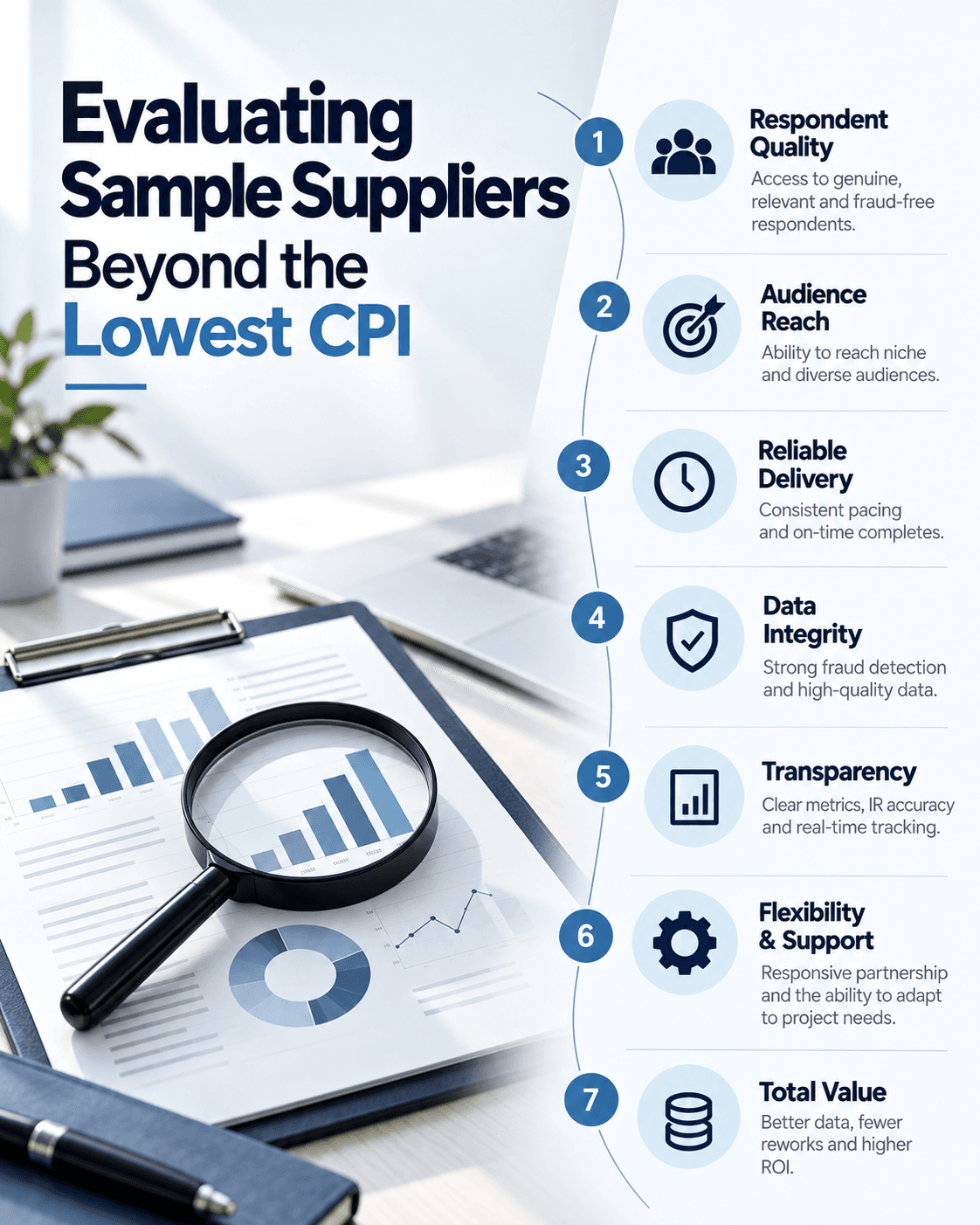
Choosing the right sample partner requires moving away from superficial bid comparisons toward a structured, multi-dimensional evaluation framework. This guide outlines a practical 7-pillar framework for evaluating sample suppliers based on true operational capabilities, and explains how modern platforms like the SoftSight Open Network eliminate the guesswork from vendor selection.
The Trap of Lowest-CPI Procurement
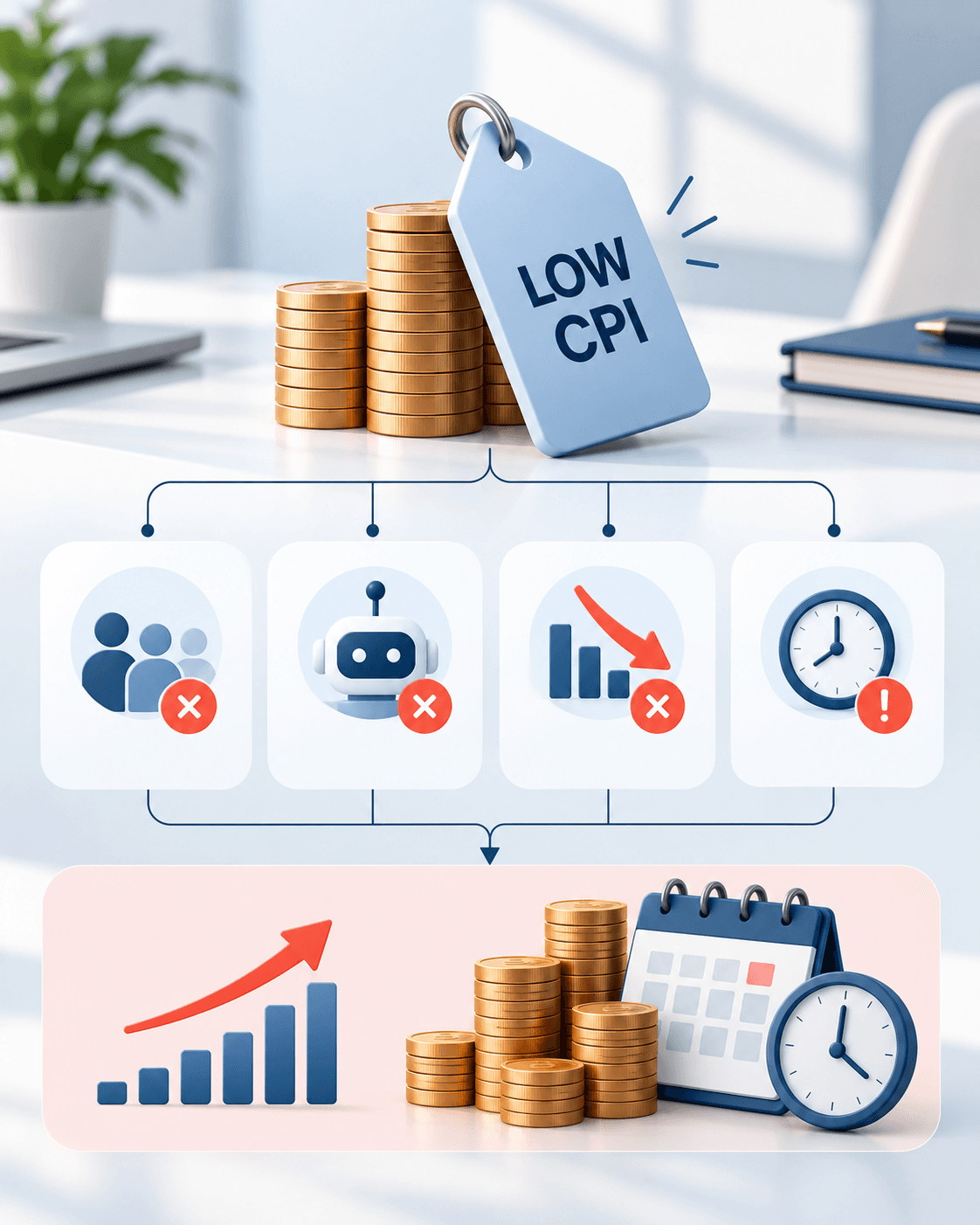
When sample selection relies strictly on price, research operations fall victim to adverse selection. Sample providers operating under heavy margin pressure may rely on compromised supply channels, aggressive incentive models, or loose quality gating to hit low price points.
THE LOW-CPI PROCUREMENT ILLUSION
- Quoted Advantage: Low initial Cost Per Complete (CPI)
- Hidden Operational Tax: High screener drop-offs, bot traffic scrubbing overhead, mid-fieldwork quota stalls, and emergency spot-market re-fielding costs.
- Real Outcome: Higher total cost of ownership (TCO) and delayed report delivery to project stakeholders.
The 7-Pillar Supplier Evaluation Framework
Audience Fit & Recruitment Sourcing
Evaluate recruitment channels (proprietary double opt-in vs. ad networks), profiling depth, and 30-day active yield for your specific target cohort.
Historical Observed Performance
Analyze historical track record: IR variance (realized vs. quoted), field completion ratios, and past quality rejection percentages.
Feasibility Realism & Quota Flexibility
Assess capacity at the nested quota cell level using 30-day active panelists rather than aggregate registered panel counts.
Data Quality & Fraud Protection
Verify pre-entry validation checks (device fingerprinting, IP filtering, proxy detection) and cross-panel deduplication guarantees.
Delivery Velocity & Pacing Curve
Review delivery curves to ensure consistent pacing across early, mid, and late field cycles without abrupt drop-offs.
Total Cost of Ownership (TCO)
Calculate true financial impact including rejection policies, minimum quota fees, and internal data cleaning overhead.
Commercial Readiness & Integration
Confirm existing MSAs/NDAs, seamless tracking parameter pass-through, and programmatic API integration support.
TCO = (Quoted CPI × Delivered Completes + Internal Overhead) / Valid Usable Completes
Pre-Flight Supplier Audit Checklist
- Run a 10% Soft Launch: Verify actual IR, drop-off rates, and link parameter pass-through before committing full study volume.
- Inspect Sample Attribution: Require clear tagging of sample sources to prevent unvetted third-party broker traffic.
- Benchmark Quoted IR: Flag quotes that assume unrealistically high conversion rates compared to historical averages.
- Test Link Redirect Integrity: Run end-to-end test completes, screenouts, and over-quotas to verify clean postback handling.
How SoftSight Open Network Eliminates Guesswork
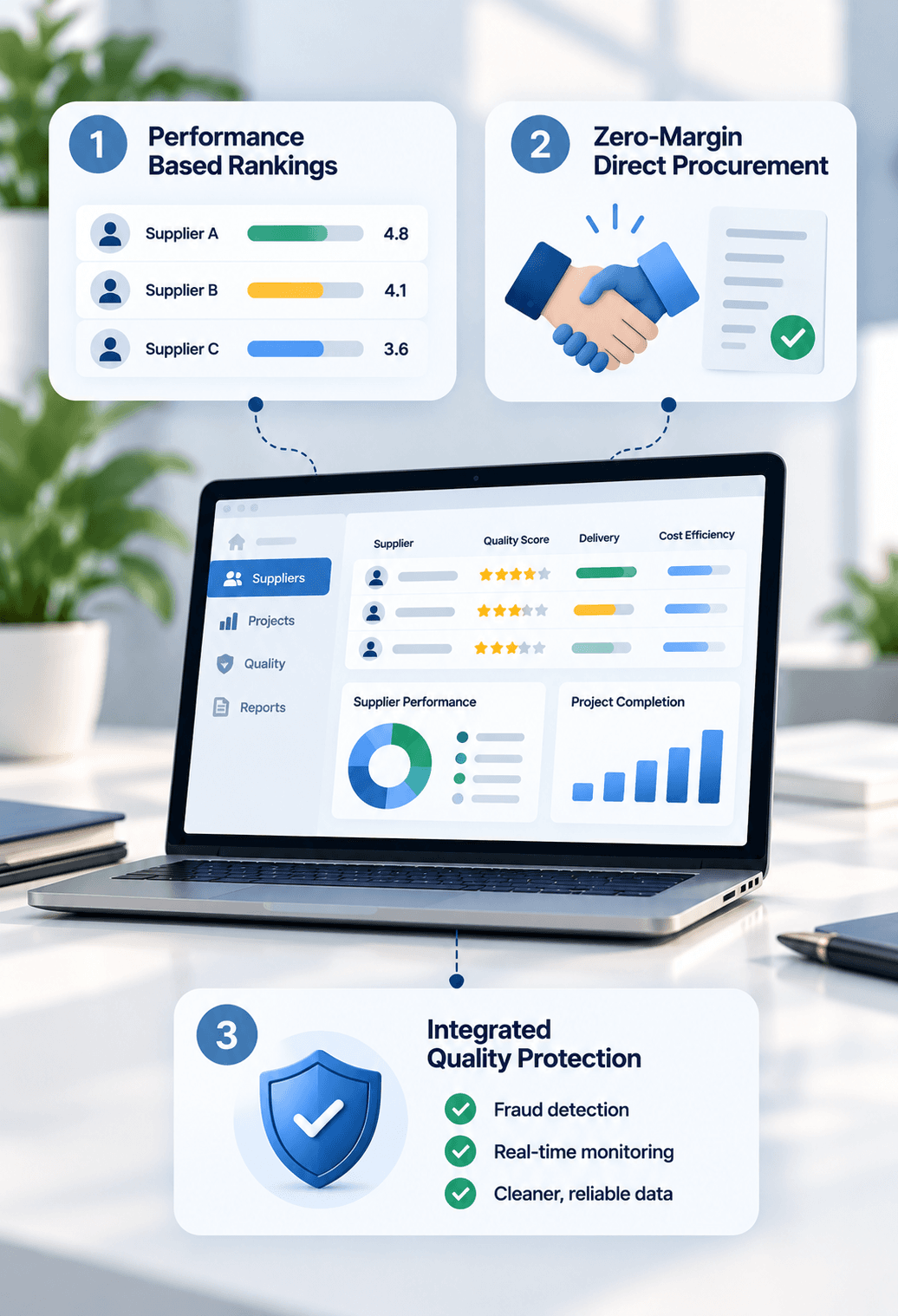
SoftSight transforms sample procurement through the SoftSight Open Network, an operational intelligence and vendor directory layer that shifts supplier evaluation from subjective claims to verified performance metrics.
Standings Based on Observed Performance
Instead of relying on capabilities decks, the SoftSight Open Network evaluates suppliers based on observed operational metrics tracked across actual studies: Incidence Rate Accuracy, Delivery Reliability Score, Data Quality Index, and Pacing Health.
Zero-Margin, Direct Procurement
SoftSight charges zero transaction commissions or markups on sample transactions. You contract directly with named suppliers at rates you negotiate, maintaining complete source attribution and commercial transparency.
Integrated Quality Protection via SurveyGuard
Evaluating supplier quality is simplified with integrated real-time protection engines like SurveyGuard, inspecting entrants across 15 detection layers in under 16 milliseconds at entry to block bots and fraud.
Supplier Evaluation Matrix
| Evaluation Criteria | High-Risk Selection (CPI Focus) | Best-Practice Selection (Framework Focus) | SoftSight Open Network Advantage |
|---|---|---|---|
| Selection Basis | Lowest quoted CPI | 7-Pillar evaluation (Fit, Quality, Speed, TCO) | Observed performance scores from past studies |
| Feasibility Assessment | Total registered panel size | Active 30-day yield & sub-quota depth | Historical delivery reliability data per cohort |
| Quality Verification | Post-field manual data cleanup | Pre-entry gating & cross-panel deduplication | Integrated SurveyGuard (<16ms) entry protection |
| Pacing & Speed | Promised turnaround time | Verified delivery curve & capacity limits | Real-time pacing tracking & automated alerts |
| Pricing & Cost Model | Base CPI quote | Total Cost of Ownership (TCO) calculation | Direct vendor rates with 0% transaction markup |
| Vendor Attribution | Blended, anonymous broker pools | Transparent, single-source tracking | 100% attributed respondent logs per supplier |