Blended sample sourcing boosts research reach and resilience, but requires strict transparency and a tailored decision framework to prevent hidden data distortions from turning it into a liability.
What Is Blended Sample Sourcing
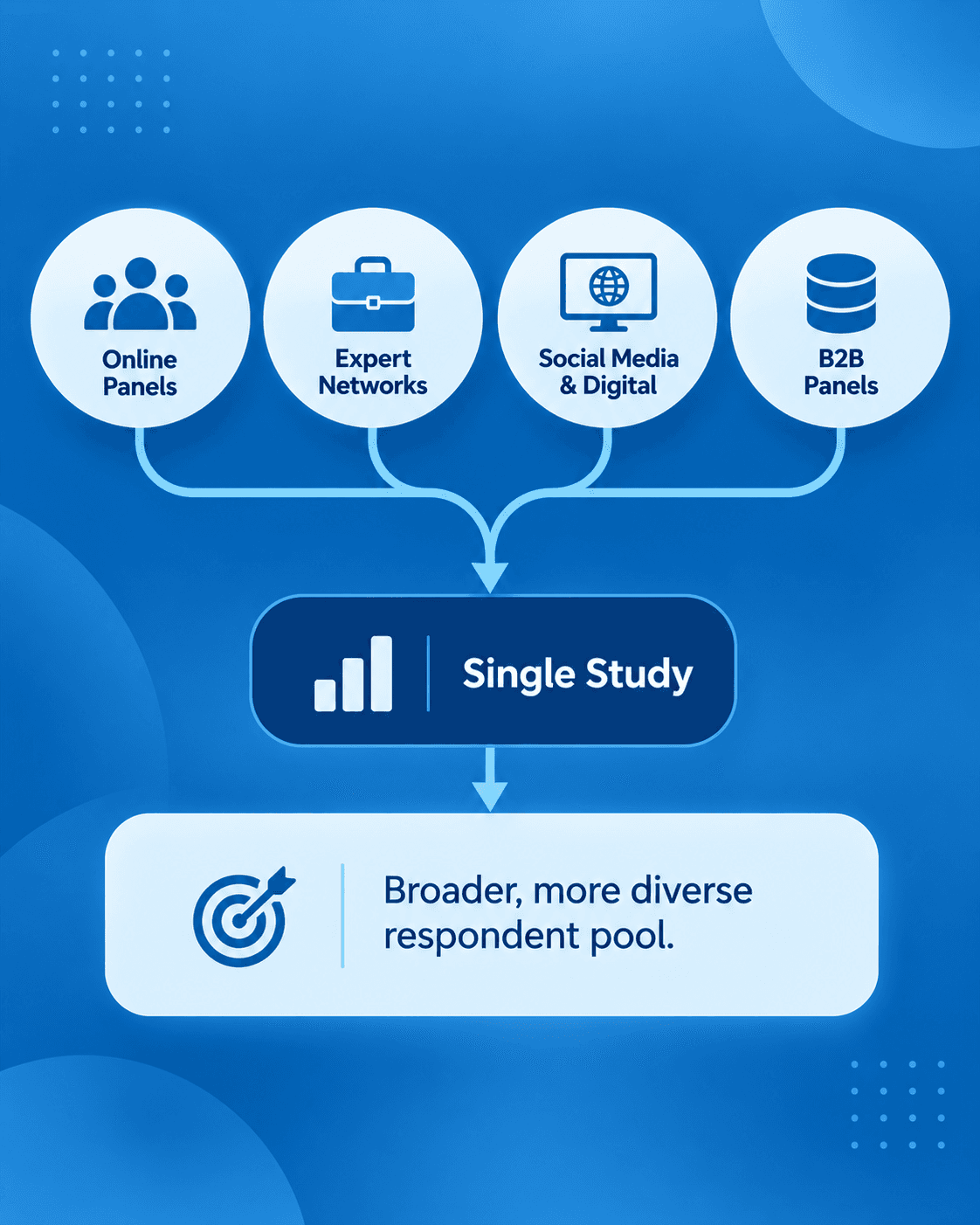
Blended sample sourcing means drawing respondents from two or more panels, expert networks or other recruitment channels to complete a single study instead of relying on a single vendor. Typical blends in business research combine expert networks with B2B panels, or mix online panels with social media and other digital sources to create a broader, more diverse respondent pool. In quantitative surveys this practice is often called sample blending or multi source sampling and is especially common in online research environments where many platforms can connect to hundreds of sources via programmatic APIs.
Why Blended Samples Became a Feature
Researchers turned to blended samples because single panels rarely deliver perfect coverage of complex target audiences, especially in B2B, niche consumer segments or multi country studies. Using multiple sources increases reach and feasibility, letting teams hit difficult quotas and gather enough responses without inflating costs or abandoning hard to reach groups. Blending can also stabilize results over time since no single supplier controls the majority of completes, making it easier to swap out underperforming vendors without distorting the overall composition of the sample.
Core Benefits When Blending Works
When carefully planned, blended sample sourcing offers at least three clear benefits:
- More representative data: Combining panels, communities and other sources helps reduce over or under representation of particular demographics or behaviors, improving overall balance and reducing bias.
- Greater granularity: Access to more respondents from different sources supports deeper segment cuts and more detailed subgroup analysis, which is especially valuable in B2B decision making.
- Operational resilience: If one supplier fails on quality or feasibility, others in the blend can fill the gap, keeping fieldwork on track and making longitudinal comparisons more robust.
The Hidden Risks Inside Blended Sourcing
The same features that make blending attractive can create serious liabilities when left unmanaged.
- Duplicate Respondents: First, the risk of duplicate respondents rises sharply once multiple suppliers tap similar underlying sources, particularly in programmatic environments where hundreds of sub sources feed into multiple platforms. Without strong deduplication protocols, the same person can appear several times under different IDs, inflating sample sizes and distorting estimates.
- Mode Effects: Second, differences in incentive structures, recruitment methods and panel management policies across suppliers can subtly shift respondent behavior, creating mode effects inside the blended dataset. For example, respondents motivated mainly by high cash payouts may be more prone to speeding or satisficing than those engaged through points or community membership, which can affect data quality if one type dominates key segments.
- Diminishing Returns: Third, blending too many sources quickly hits a point of diminishing returns. After four or five sources, overlap and complexity grow faster than gains in representativeness, making quality control and documentation harder while yielding limited additional diversity.
When Blended Sample Is Acceptable
Blended sourcing is generally a good fit when the project goals focus on broad patterns rather than precise estimates for a narrowly defined population.
Ad hoc brand and concept tests, new product evaluations and ongoing trackers aimed at understanding overall trends or directional shifts usually benefit from a well designed blend. In these contexts, the primary need is to cover the market adequately, manage feasibility and protect against vendor specific biases, not to trace every respondent back to a single, fully documented source.
Blending is also acceptable when you have strong operational safeguards: clear quotas aligned to trusted benchmarks, consistent survey design across sources, and robust deduplication technology such as digital fingerprinting or hashed email matching. When these controls are in place, the blend can function as a feature that improves quality rather than a black box that hides problems.
When Blended Sample Becomes a Liability
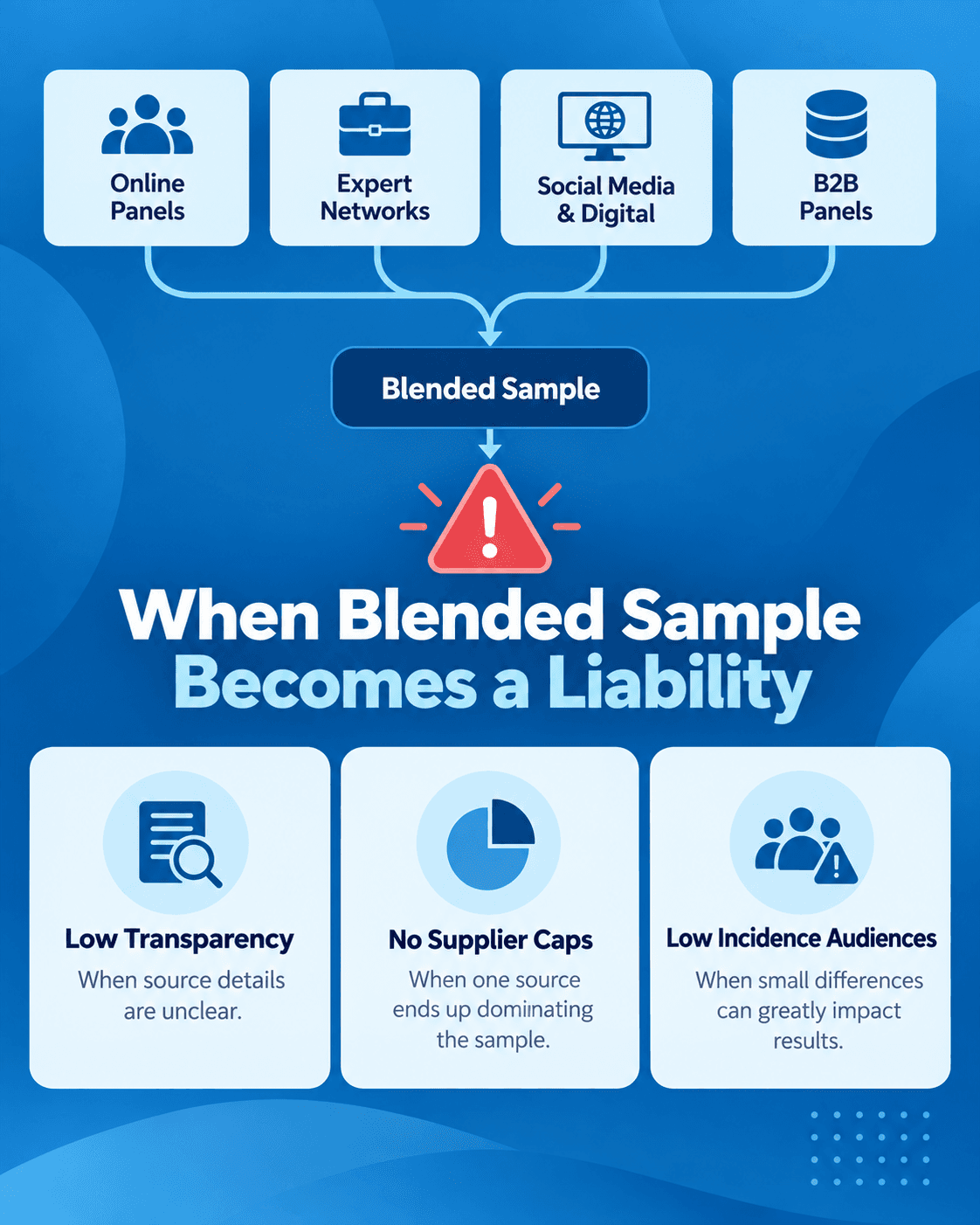
Blended sample turns into a liability when the research questions demand high levels of transparency, reproducibility or formal accountability, and yet source information is weak or opaque.
In regulatory, policy or academic studies, stakeholders expect detailed documentation of how data were generated, including who provided respondents, how they were recruited and how any weighting or cleaning decisions were made. If suppliers cannot provide clear breakdowns of sample contributions, or if overlapping programmatic sources make deduplication and bias assessment uncertain, confidence in the findings can be undermined.
Liability also rises when you blend sources without limiting the proportion any one supplier contributes, allowing one unknown sub source effectively to dominate the dataset while appearing as part of a diverse mix. Without caps, conservative blends that keep each supplier under roughly one quarter of total respondents can slide into unbalanced compositions that distort the target population.
Finally, blended samples are problematic when they are used for very low incidence populations, where small differences in recruitment or deduplication rules can have outsized effects on estimates. In these cases, every individual observation carries more weight, so opaque blending can compromise validity and ethical obligations to represent rare groups accurately.
Why Source Transparency Matters
Research transparency broadly means clearly stating how information and evidence were gathered, interpreted and shared so that others can understand, assess and, where appropriate, reproduce your work. For survey projects, that includes documenting sampling frames, recruitment channels, cleaning rules, weighting decisions and any changes made between waves.
Scholars and practitioners have emphasized that good transparency involves explaining where sources are located, how they were produced, why particular sources were chosen and how they support key claims. In blended sampling, this translates into disclosing the mix of panels and channels used, the percentage contribution from each, deduplication approaches, and any access or ethical constraints on sharing underlying data.
Transparency is not just a formal standard. It directly affects trust. Stakeholders deciding on large investments or public policy need to know whether results reflect real attitudes or artifacts of recruitment and cleaning choices buried inside the sample blend.
Decision Framework
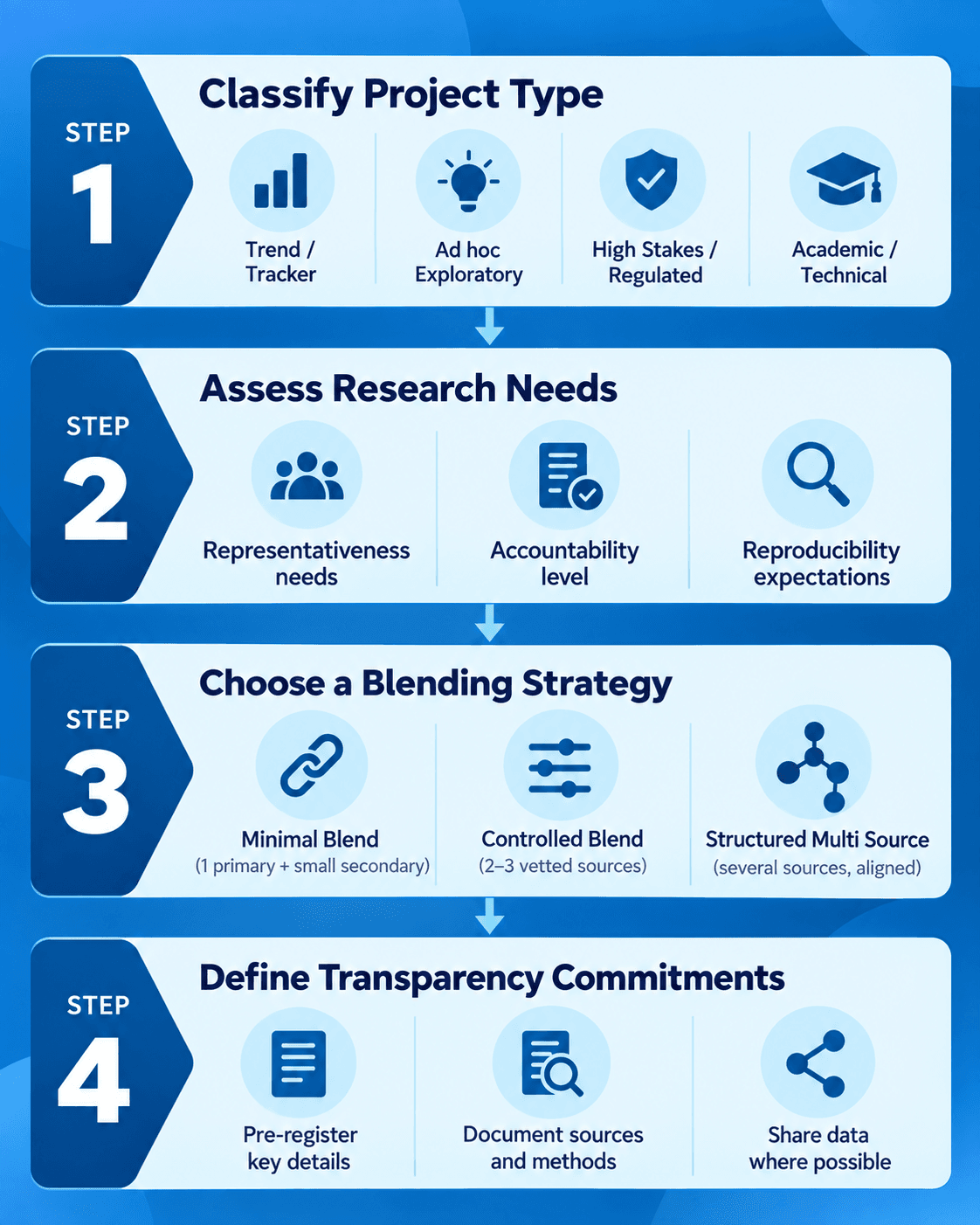
Step 1: Classify Project Type
A practical way to decide how much blending and transparency you need is to start by classifying the project into broad types:
- Trend or tracker studies: Ongoing measures of brand health, usage, satisfaction or broad political attitudes where comparability across waves is crucial.
- Ad hoc exploratory studies: One off concept tests, messaging checks or segmentation exercises used to inform tactical decisions.
- High stakes or regulated studies: Evaluations informing public policy, compliance, safety or large capital decisions that may be audited by external parties.
- Academic or technical research: Work intended for publication in fields that expect rigorous documentation and potential data sharing.
Each category carries different expectations for both sample structure and transparency, influencing whether blended sourcing is a feature or a potential liability.
Step 2: Assess Research Needs
Next, evaluate the specific needs of the project along three dimensions:
- Representativeness needs: Do you mainly need a reasonably balanced view of a broad audience, or precise estimates for a narrowly defined population with well known benchmarks.
- Accountability level: Will results be used internally for directional decisions, or externally for formal reporting, regulation or academic claims that require traceable evidence.
- Reproducibility expectations: Are others likely to attempt replication or secondary analysis, which would require access to detailed sampling and cleaning information.
Projects that score high on accountability and reproducibility should tilt toward fewer sources, more detailed documentation and more conservative blending, even if that slightly reduces feasibility. Those that are exploratory or internal may accept more aggressive blending as long as core quality safeguards are in place.
Step 3: Choose a Blending Strategy
Based on project type and needs, you can choose among three broad blending strategies:
- Controlled blend: Use two to three carefully vetted panels or networks with clear caps on contribution from each, strong deduplication and full post field source breakdowns. This pattern suits most trackers and many ad hoc studies, balancing quality and feasibility while keeping transparency manageable.
- Minimal blend: Use a single primary supplier supplemented by a small secondary source only where feasibility issues arise, documenting the conditions under which the secondary source is activated. This is appropriate for high stakes or low incidence studies where sample control is crucial and each extra source adds complexity.
- Structured multi source: Use several sources but anchor them to a common benchmark and shared design, with careful quotas and weighting to align the blend to a known population profile. This approach works for large scale market studies where broad coverage is essential and teams are prepared to invest in detailed documentation and weighting transparency.
- Across all strategies, avoid blending purely for the sake of maximizing the number of connections. After four or five sources, returns tend to diminish and overlap issues grow sharply.
Step 4: Define Transparency Commitments
Finally, specify your transparency commitments at the design stage and treat them as part of the research plan, not as an afterthought.
Good practice includes pre registering key aspects of the study for more formal projects, such as hypotheses, sampling plans and analysis strategies, so that deviations from the original plan are visible. It also involves planning appendices or technical documentation where you will describe sample sources, their contributions, deduplication rules and weighting procedures.
For some studies, you may commit to sharing anonymized data through repositories or controlled access venues once ethical and legal conditions allow, making it easier for others to evaluate and reuse the results. Even when full data sharing is not possible, you can still adopt open annotation or other mechanisms to clarify how particular data segments underpin key findings.
By deciding these transparency elements up front, you reduce the risk that a blended sample that looked like a feature during fieldwork later becomes a liability when stakeholders ask hard questions about provenance and validity.
Practical Safeguards to Keep Blending a Feature
Several concrete practices help keep blended sampling in the feature category:
- Limit supplier shares: Keep any individual partner below roughly one quarter to one third of total completes so that no single unknown sub source silently dominates the dataset.
- Standardize instruments: Use consistent survey wording and layout across sources to minimize execution differences that could create artificial variation.
- Enforce deduplication: Combine vendor deduplication with your own checks using digital fingerprints, IP addresses, device IDs and response pattern review.
- Monitor incentives: Understand how each supplier motivates respondents and watch for patterns that correlate with speeding or poor responses.
- Weight carefully: Use weighting aligned to credible benchmarks and document both the rationale and the impact on key estimates.
- These safeguards do not eliminate all risk, but they significantly reduce the chance that blending will introduce invisible problems that are hard to explain later.
Bringing It All Together
Blended sample sourcing started as a pragmatic solution to reach, feasibility and bias concerns in modern online research and, with the right controls, it genuinely improves data quality and resilience. At the same time, growing complexity in programmatic sample ecosystems, increasing expectations around transparency, and higher stakes in how research informs decisions mean that uncontrolled blends can quickly shift from advantage to liability.
By classifying project types, assessing research needs, choosing appropriate blending strategies and committing to clear transparency practices in advance, you can make sure that blended sample remains a feature, not a hidden weakness that undermines trust in your work.