This is a speculative piece, in the specific sense that it describes a future that does not yet universally exist — but that is built from capabilities and trends that are already present.
Monday, 9am
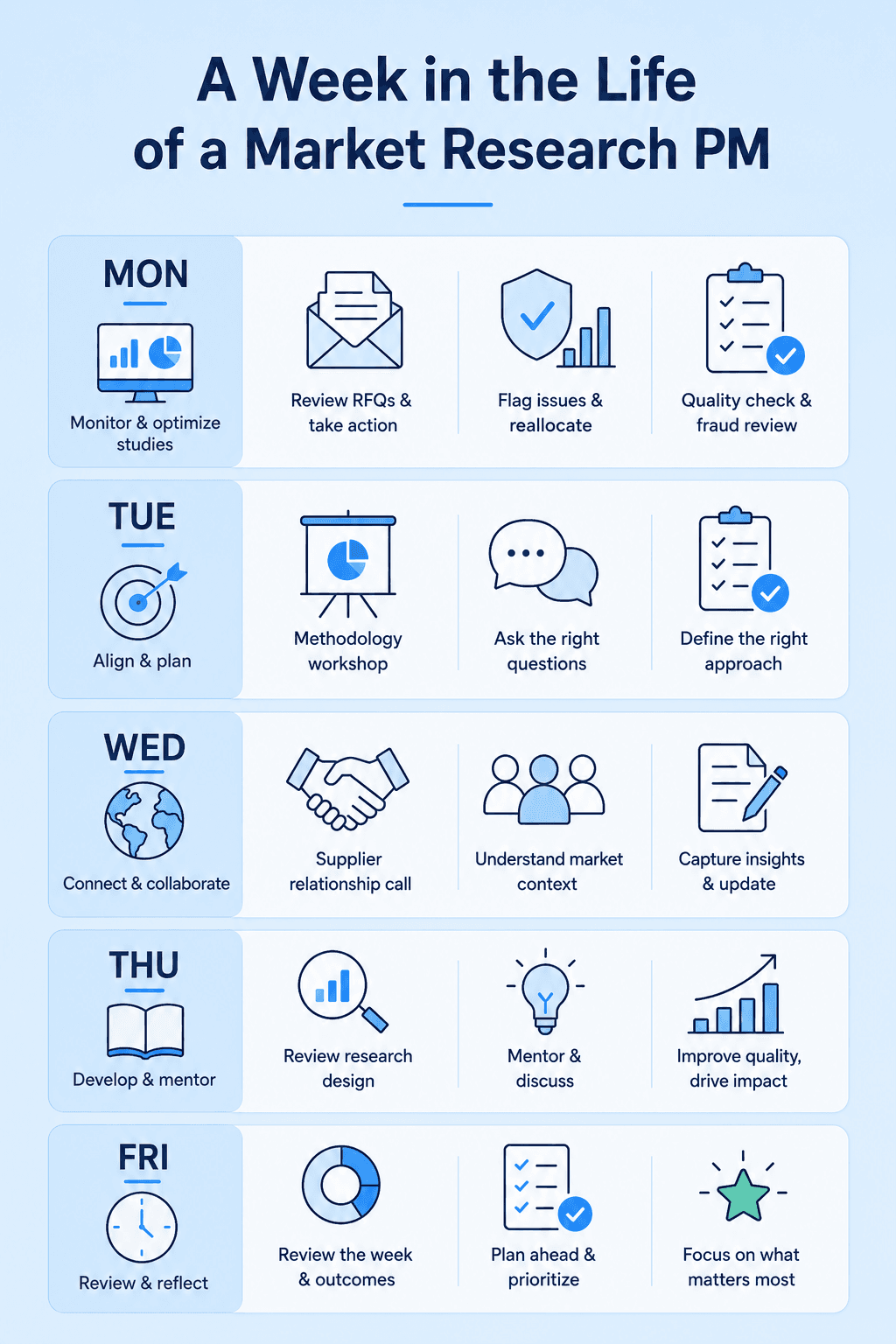
She opens the platform. Fourteen studies are in field. The dashboard shows quota fill by supplier, by demographic cell, by study. Three studies are on track. Two are ahead of pace, so she adjusts the traffic allocation to prevent overfill. One is behind on a specific cell, and the platform has already flagged a backup supplier and drafted the reallocation request. She approves it. Total time: eleven minutes.
This is not science fiction. The technology to aggregate supplier feeds, monitor quotas in real time, and trigger automated reallocation already exists. What is new is the integration. What is new is the decision to build an operational backbone that treats the project manager's time as a scarce resource worth protecting
Monday, 9:30am
Three new RFQs went out automatically on Friday, timed for supplier business hours in their respective time zones. Quotes from seven suppliers have arrived. The platform has read them all. It shows her a comparison: recommended actions for each. Two she accepts immediately. Three she reviews the counter-offer the platform has drafted. She edits one, approves the others. Two suppliers have quoted above her maximum, and the platform has already drafted a rejection. She reviews and sends. Total time: twenty-two minutes.
Last year, this same process would have consumed her entire morning. It would have involved opening five different email threads, copying pricing into a spreadsheet, checking currency conversions, and writing individual responses that varied only in the name of the supplier and the amount of the counter-offer. The platform has not removed her judgment. It has removed the friction that prevented her from exercising judgment.
The Afternoon
She reviews the soft launch data for a study that opened last week. The fraud rate for Supplier C is running at eight percent, higher than the platform threshold. She reviews the flagged respondents, confirms the pattern, and pauses Supplier C's traffic. The platform will automatically notify the supplier, log the incident for future vendor scoring, and redistribute the remaining sample. She spends forty minutes on this because fraud detection is a place where human pattern recognition still matters. She is not clicking through rows in Excel.
She is looking at visualizations of response patterns, time stamps, and open-end consistency that the platform has already surfaced.
Then she spends forty minutes reviewing the questionnaire for a new study because the client brief has a complexity she wants to think about carefully. The client is a healthcare brand entering a market where regulatory language shapes consumer perception. The difference between asking about a product and asking about a treatment is not a detail the platform can calibrate. It requires someone who understands the client's business, the respondent's mindset, and the way words create bias.
That last sentence is the point. The afternoon contains real research thinking. Not because there is nothing operational to do. There is always something operational to do. But because the operational layer is handled by infrastructure that is faster, more consistent, and more comprehensive than email and spreadsheets.
Tuesday
She runs a methodology workshop for a new client. They are not sure whether they need a segmentation or a brand tracker. She has time to walk them through the trade-offs because she is not spending the morning chasing a supplier for a status update that the platform already gave her at 6am. She draws on the whiteboard. She asks questions about their decision timeline, their internal stakeholders, their appetite for statistical complexity. By the end of the hour, they have co-designed an approach that she knows will actually answer their question. Not the question they wrote in the brief. The question they are really trying to solve.
Wednesday
She has a standing call with her primary supplier in Brazil. The platform handles every transaction between them. It pays invoices, tracks SLA compliance, and flags discrepancies without her intervention. But the platform cannot build trust. It cannot ask about the supplier's new panel expansion into rural regions. It cannot discuss whether the recent political climate is affecting response rates in ways that the data has not yet shown. She takes notes. She adjusts her mental model of that supplier's strengths. She files away an insight about regional bias that will matter for a study six months from now.
Thursday
She mentors a junior researcher who joined the agency three months ago. They sit together and review a conjoint design the junior drafted. She explains why the number of attributes affects the sample size calculation. She explains why the platform's default recommendation assumes a certain level of respondent engagement, and why this particular category might require a different assumption. The junior asks questions that make her reconsider her own default settings. This is the kind of conversation that used to happen only on the days when both of them were not underwater with fieldwork logistics.
Friday
She reviews her week. Fourteen studies progressed without a single email thread about quota management. Three RFQs were negotiated and awarded without a spreadsheet. One fraud issue was caught and resolved before it contaminated the full sample. She spent six hours in direct client or supplier conversations that advanced actual research objectives. She spent two hours on questionnaire and methodology design. She spent one hour on administrative oversight, most of it reviewing recommendations rather than generating documents from scratch.
This is not a story about working less. It is a story about working on the right things.
The Resistance
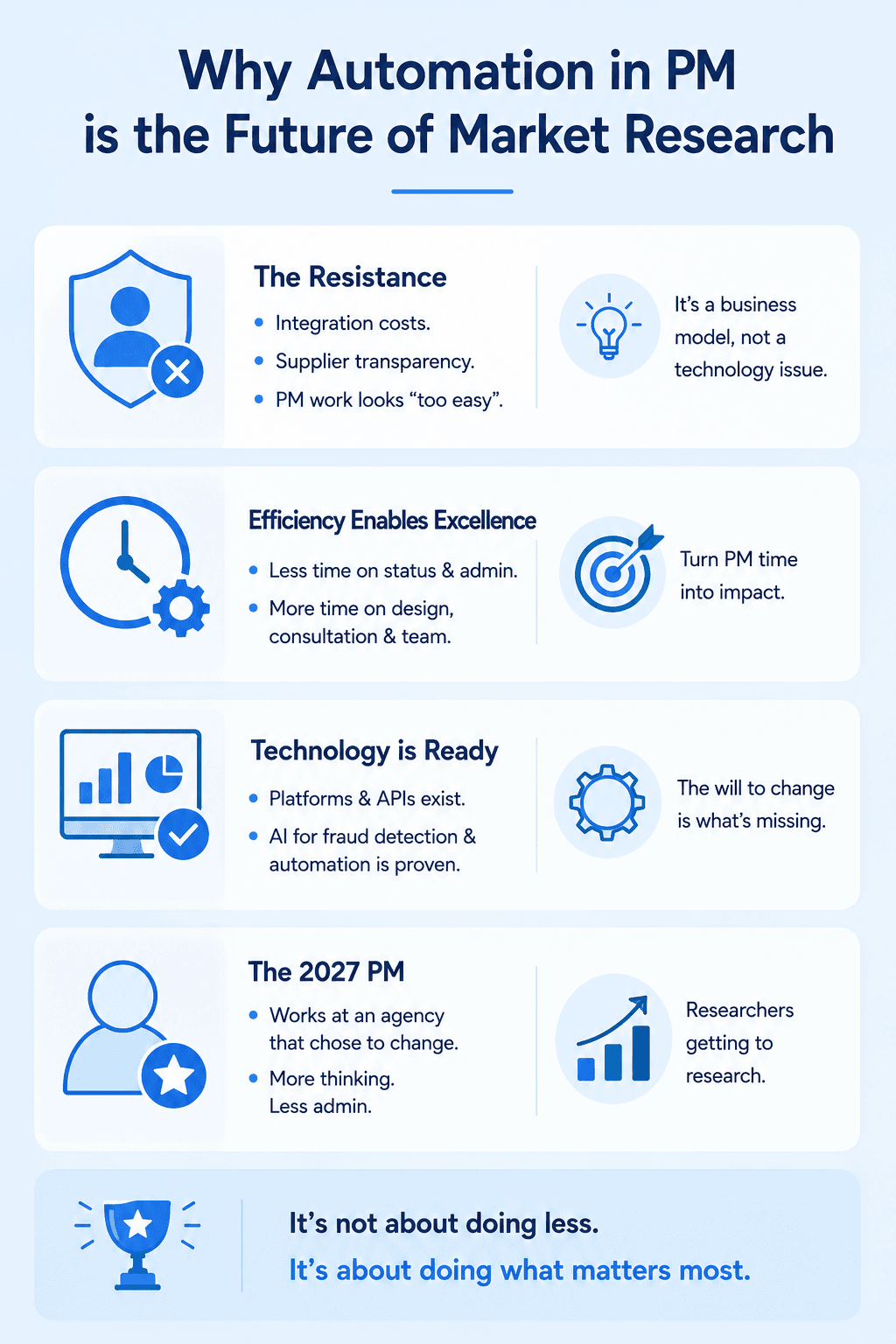
Some agencies will read this and say it sounds expensive. That integration costs money. That suppliers will resist being plugged into a system that makes their pricing transparent. That clients will not pay for project management if it looks too easy.
Those objections are real. But they are not about technology. They are about business models that profit from inefficiency. They are about agencies that bill by the hour and therefore have an incentive to keep hours high. They are about an industry that has confused busyness with value.
The goal is not to make research agencies efficient. It is to make research agencies excellent. Efficiency is what makes excellence possible.
When a project manager spends her morning on status updates, she is not being diligent. She is being wasted. When she spends her afternoon on questionnaire design, client consultation, and team development, she is being used as she should be. The research industry does not need fewer project managers. It needs project managers who are allowed to think.
This future is not dependent on technology that does not yet exist. It is dependent on technology that exists today being adopted by agencies who are ready to stop accepting that the current way of working is the only way. The platform is available. The APIs exist. The machine learning models that flag fraud and draft emails are already in production in other industries.
What is missing is the will to restructure operations around the belief that a project manager's time is better spent on judgment than on administration. That belief is not a technology problem. It is a leadership decision.
The PM in this story is not a futurist. She is simply someone who works at an agency that made the decision. She gets her Mondays back. She gets her afternoons back. She gets to be the researcher she was hired to be.
And that is what 2027 looks like. Not robots replacing researchers. But researchers finally getting to research.